The 20 AI Prompts Every Marketer Needs In 2025
Artificial Intelligence isn’t the future of marketing. It’s the now. And if you’re a savvy marketer, you already know that how you prompt your AI tools can make or break your output. It’s the difference between vague fluff and high-impact content that drives traffic, engagement, and leads.
So how do you get there?
It all starts with mastering your AI prompts. Below are the top 20 AI prompt examples that marketers in 2025 are using to turbocharge their strategies across content creation, SEO, social media, email, and more. Each prompt is paired with a quick rationale to help you understand why it works so well.
1. “Explain [complex topic] to a beginner in 300 words.”
Why it works: This helps break down intricate topics for top-of-funnel educational content. Perfect for awareness-stage blogs and lead magnets.
2. “Compare [product/service] vs [competitor] from a buyer’s perspective.”
Why it works: Comparison content ranks high in SEO and supports decision-stage buyers. It also positions your product strategically.
3. “List 10 quick tips for [audience] to solve [specific problem].”
Why it works: Listicles are highly shareable and great for social snippets and SEO.
4. “Draft an Instagram carousel post summarizing the key points from [URL or topic].”
Why it works: Converts longform content into engaging, visual social posts.
5. “Write an email drip campaign for [offer] targeting [persona] with [tone of voice].”
Why it works: Specificity in audience, tone, and format results in sharper and more targeted emails.
6. “Generate 5 blog titles about [topic] using a fun and authoritative tone.”
Why it works: Headlines are everything. This helps break creative blocks and refine your editorial calendar.
7. “Create an SEO-optimized blog outline for [keyword phrase] including a compelling intro and CTA.”
Why it works: Helps content writers focus on structure and flow while aligning with search intent.
8. “Summarize this 1,500-word article into a 100-word LinkedIn post.”
Why it works: Perfect for repurposing content and staying consistent across platforms (a core IMC strategy).
9. “Explain the ROI of [service] in plain English for SMB owners.”
Why it works: Works great for landing page copy or ad headlines aimed at non-technical audiences.
10. “Give me a set of FAQs for [product/service] including objections and clear answers.”
Why it works: Helps sales teams and customer support stay on message, while also boosting SEO.
11. “Write a persuasive call-to-action for [product] targeting [persona] at the bottom of a blog post.”
Why it works: Timely, relevant CTAs are critical for moving users from interest to action.
12. “Transform this list of bullet points into a compelling About Us page for a [type of business].”
Why it works: AI excels at voice and tone customization. This prompt ensures consistency across brand touchpoints.
13. “Brainstorm 10 ideas for a lead magnet for [persona] interested in [topic].”
Why it works: Shortens the ideation cycle and keeps you aligned with customer pain points.
14. “Draft a 60-second script for a YouTube ad promoting [product] with a humorous tone.”
Why it works: Video scripting with tone guidance helps inject creativity and boosts brand recall.
15. “Rewrite this blog paragraph to make it more emotionally compelling without changing the meaning.”
Why it works: Helps improve engagement and reader retention.
16. “Write a promotional LinkedIn post tailored to [job title] in [industry].”
Why it works: Makes B2B content feel personal and relevant.
17. “Create a keyword cluster for [main keyword] and draft potential blog titles for each.”
Why it works: Boosts your content strategy with targeted SEO insights.
18. “Write a press release for the launch of [product] focusing on innovation and social impact.”
Why it works: PR with a purpose gets more media attention and builds brand authority.
19. “Convert this customer testimonial into a case study introduction.”
Why it works: Turns raw feedback into polished narratives that sell.
20. “Act as a prompt engineer and generate 5 improved prompts for [your marketing goal].”
Why it works: Meta-level prompting helps you become more effective and creative with your AI use.
Why These Prompts Work: A Marketer’s Playbook
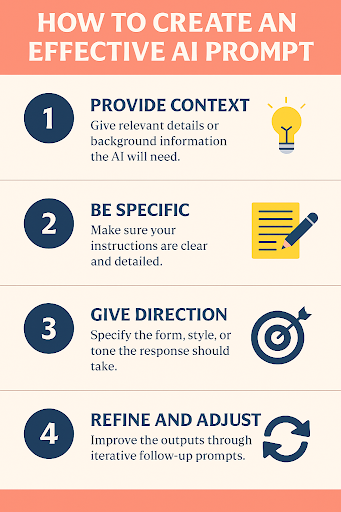
All of these prompts have one thing in common: they lean into clarity, context, and conversion. They reflect the principles of Integrated Marketing Communications (IMC), ensuring that messaging is consistent across platforms, audiences, and touchpoints. According to IMC best practices, using structured, specific prompts also enables better reuse and remixing of content—a major time-saver and brand-builder.
Moreover, these prompts align with tools like Ubersuggest, Canva, Mailchimp, and social schedulers like Hootsuite, making execution smoother. Combine these tools with the right prompt and you’ve got a scalable content engine that feeds blogs, ads, social posts, emails, and more—all from a single seed idea.
And the best part? Most marketers report that with the right prompt, AI-generated content only needs light editing. That’s less time fixing, more time executing.
Ready to Power Up Your Prompt Game?
Use these 20 examples as a base to build your own prompt playbook. Add variations, test tones, tweak audiences. Treat each prompt as a blueprint, not a script.
With smart prompting, AI stops being a novelty and becomes your most dependable marketing assistant.
Need help building your own prompt framework? Just say the word. Let’s turn your ideas into content that converts.