The 2026 GTM Job Market: Fewer Seats, Different Skills
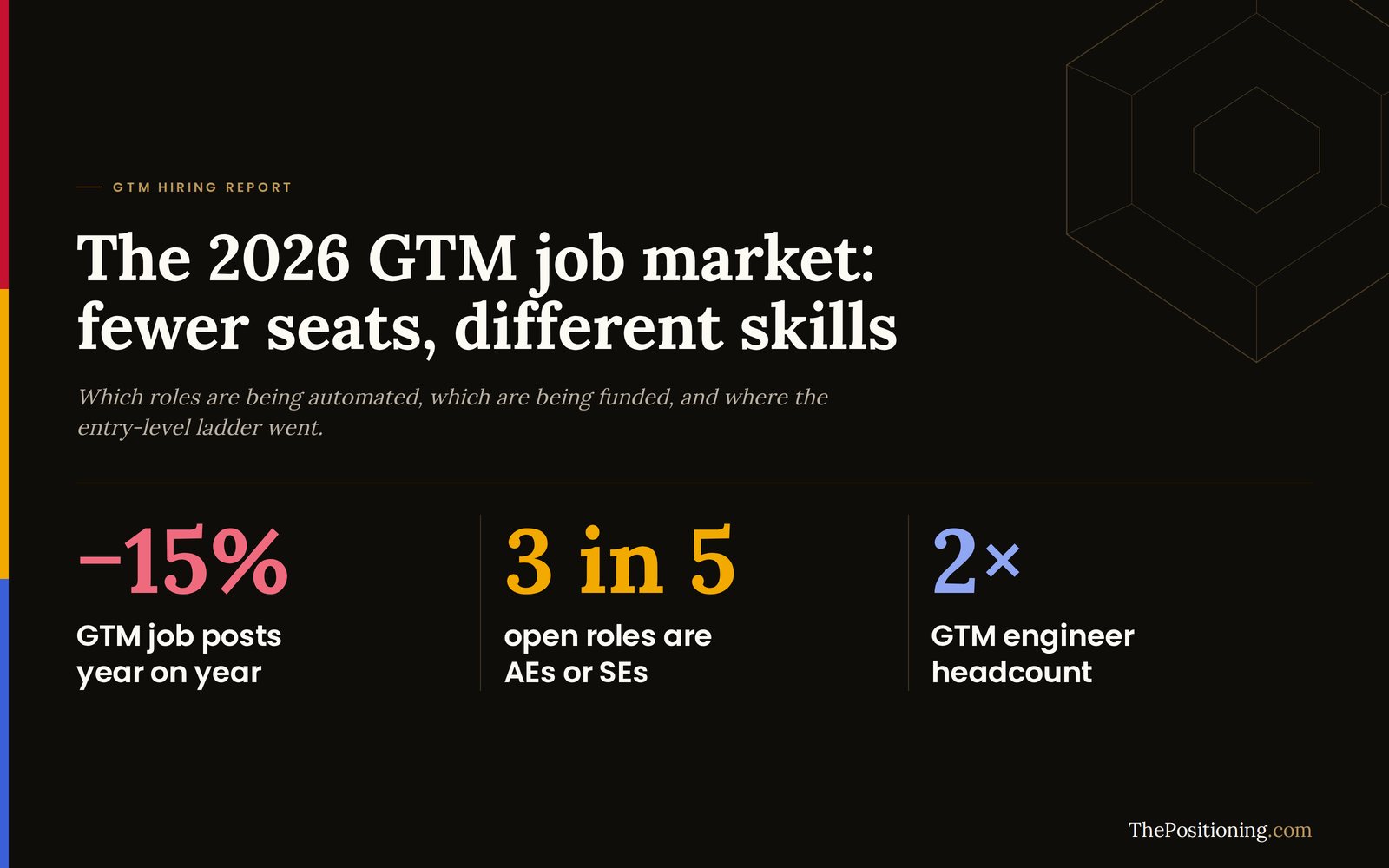
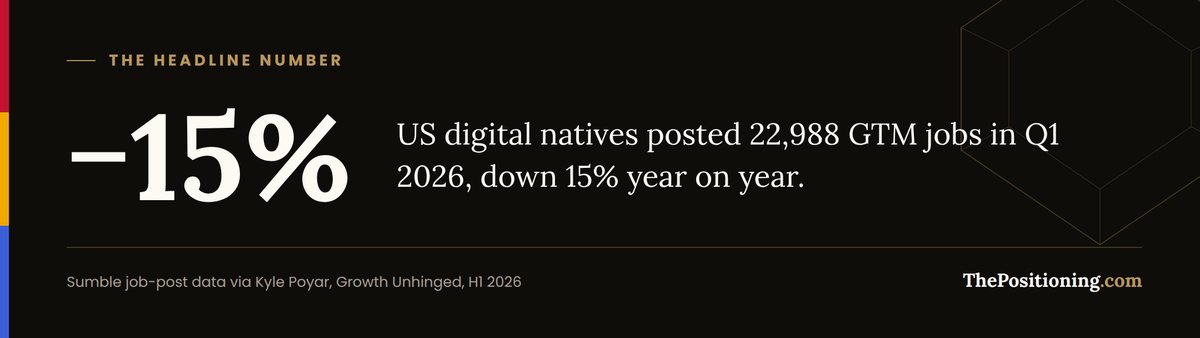
In Q1 2026 there were 22,988 U.S.-based digital native firms’ Go To Market (GTM) job openings. This represents a 15% reduction from the prior-year period; based upon Sumble’s Job Posting Data compiled by Kyle Poyar. A significant decrease in GTM positions has been widely observed among employers in various industries over the past few months. Many have referred to this trend as a “job market vibe.”
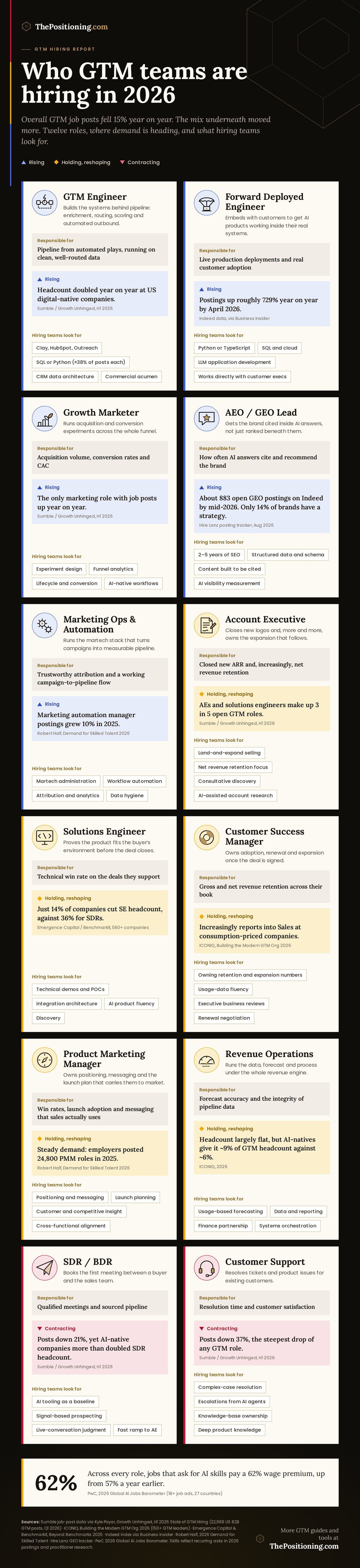
While the total number of GTM jobs will likely be highlighted in media reports, it is the most uninteresting aspect of the data. When analyzing the data using multiple categories such as roles/functions, we see a much clearer picture of how GTM teams are being restructured. Revenue teams are not just decreasing in size but rather are undergoing a transformation. Sales Development job posts decreased by 21%, while Customer Support posts decreased by 37% (the steepest fall of any GTM role). Account Executives/Solutions Engineers represent three out of five available GTM positions.
In addition, a new position called GTM Engineer, which barely existed two years ago, has seen its workforce double. Companies are not reducing their overall number of GTM positions; they are simply shifting funds away from one type of GTM position towards another.
The test every GTM seat is now passing or failing
Data patterns are much less complex than the roles’ names would indicate, and have existed throughout this entire calendar year. All GTM seats perform either of two functions. They provide “coverage” by touching more accounts, closing more tickets and scheduling more meetings. This type of output will increase linearly based upon the amount of people working at any given time. Alternatively, they provide “leverage.” Leverage is created when someone builds something or makes a decision that continues to pay off even after the individual has left work.
The automation of coverage positions and the funding of leverage positions has been budgeted for next year; the median organization will plan no RevOps headcount growth for 2026 and no marketing headcount growth beyond $250 million ARR. This represents the entire 2026 hiring market in just one statement. As a pure coverage position within the organization, support was the position with the largest reduction at 37%. SDRs followed closely behind with a 21% reduction.
Solutions Engineers (SEs) have been minimally impacted by cost-cutting measures; only 14% of firms surveyed by Emergence Capital and Benchmarkit (more than 560 total) cut back on their number of SEs while 36% did so with Sales Development Representatives (SDRs).
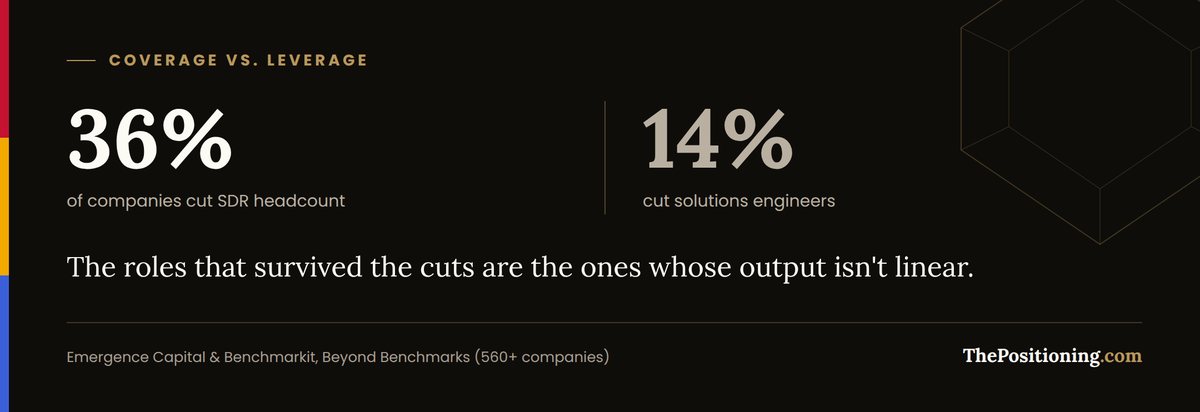
A difficult aspect of this analysis is that it does not take into consideration how well an individual performs at his/her job but rather whether their output is linear.
The math that makes the cuts rational
This phenomenon has occurred at this time as opposed to during each of the last five years when all individuals were discussing how to be efficient because there was a large enough difference in productivity to cause it to appear in the data.
ICONIQ’s 2026 research on the modern GTM org found that companies with AI deeply embedded in their go-to-market generate roughly twice the net new ARR per GTM employee as low adopters: about $640K against $370K. On the post-sale side the gap is similar, with net expansion revenue per post-sales employee running about $1.1M against $600K.

Consider this for a moment: A two times (2x) difference in revenue per head is significantly greater than what most other business-to-business (B2B) operations have been able to achieve over the last ten years using various levers. Changes in pricing cannot produce such large differences; neither can territory designs nor enablement programs.
When a productivity gap of that size appears, organizations no longer plan for growth but instead for which side of the gap they stand on. ICONIQ’s data shows the median company planning zero RevOps headcount growth for 2026, and zero marketing headcount growth above $250M ARR. What growth is planned sits in sales and post-sales, at roughly 10-20%.
The organization does not appear to be reducing its size; rather, it seems to be limiting new hires and moving around the positions it currently occupies.
The SDR number that breaks the narrative
The easy version of this story is “AI is replacing SDRs.” The data refuses to cooperate.
SDR job posts fell 21% overall. But AI-native companies more than doubled their SDR headcount over the same period.
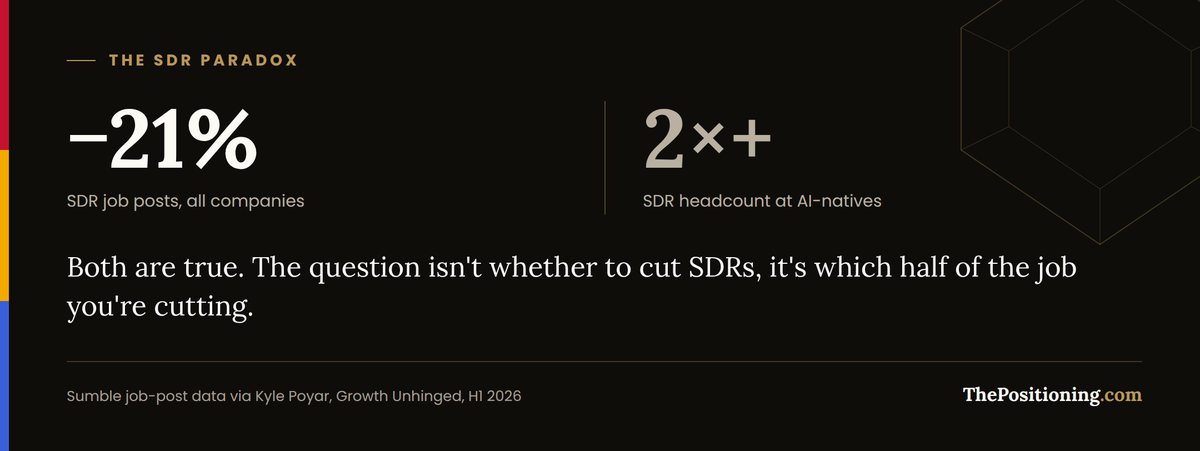
Both statements are accurate; however, it is the discrepancy between them which provides us with an understanding. Companies closest to this type of technology, those who know exactly what an AI agent is capable of doing versus what it cannot do, are hiring more people to prospect, not fewer.
However, these same companies are eliminating positions that were previously referred to as “coverage” jobs. These types of jobs included individuals sitting at desks making phone calls all day long (i.e., 200 dials per day) simply so someone would make contact with potential customers.
Funding goes toward a model of a human reading a signal and making a determination as to whether there will be a need for human intervention in order to continue the conversation. This type of decision-making process is known as “judgment.” As such, it cannot be automated nor does it have a direct relationship with how many people are involved in performing the same task.
Therefore, if you run a sales organization, this is likely the single most actionable finding in the study. Rather than asking yourself whether you should eliminate some number of Sales Development Representatives (SDRs), ask yourself which aspects of each SDR’s position you wish to remove.
The builder seats are real. Half the titles aren’t.
In 2026, the most rapidly growing GTM position is the GTM Engineer. A GTM Engineer creates the enrichment, routing, scoring and outbound systems which were previously accomplished using people. The role has doubled, and there are enough postings available now to see what companies require from candidates. There are two things you should know about these jobs.
The first thing you should know about the “technical” barrier to entry for this role is that it’s much lower than what the name suggests. In fact, both SQL and Python were listed in approximately 38% of all GTM Engineer positions posted. Therefore, the majority of these positions do not require either. The top three tools used by companies looking to hire GTM Engineers include Clay, HubSpot and Outreach. As such, this is essentially a Systems Thinking Job dressed up as Engineering, and the most common hiring mistake I’d expect this year is screening for a computer science background when the actual requirement is someone who understands a revenue motion well enough to automate it.
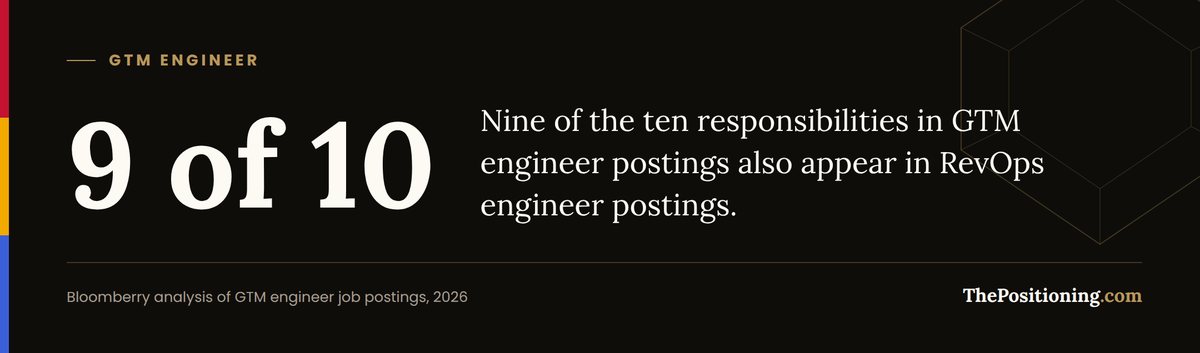
Second (and much less comfortable): nine out of ten of the items on the list of “responsibilities” for GTM engineers can also be found on the list of “responsibilities” for RevOps Engineers. So a large part of the rapid expansion in GTM engineer roles is RevOps work under a fresher title. If you’re hiring one, be honest about which job you actually need. When you apply for a job, the fact that titles have been inflated is working in your favor at present, but it will not last forever.
A brand new type of position is now available; this is the “forward deployed engineer” – someone who enters the customer’s space and gets an AI product up-and-running for them. According to Indeed’s index, postings for this role were roughly 729% higher in April 2026 than a year earlier. These roles require true engineers – those with experience using Python or TypeScript, SQL, cloud technology, and developing applications based upon large language models (LLMs). What makes it a GTM role rather than an engineering one is that the individual will be sitting directly opposite the customer’s executives. Think of it as a Solutions Engineer’s job with a commit history.
A significant number of organizations have overlooked a key aspect of strategy when they hire for both positions. These two positions were created due to the fact that the product will no longer sell itself via a demonstration. In order for the customer to believe in the product, someone needs to demonstrate how well the product works within their own organization. That’s the return of solution selling, staffed by people who can write code.
Marketing got one growth lane, and it isn’t the one you’d guess
Marketing has taken the hit we would have anticipated from a 15% contraction; however, there is one area where this does not apply – growth marketing. Growth marketing is the only type of marketing role that has seen an increase in job postings since last year. This makes sense because growth marketers build systems (experiments, funnels and lifecycle flows) rather than a volume of deliverables.
Robert Half’s 2026 talent report shows marketing automation manager postings up 10% for the same reason, alongside 24,800 product marketing roles posted in 2025, which is steady rather than spectacular.
However, the structural data is much less optimistic. ICONIQ reports that AI-native companies are allocating approximately 13% of their GTM headcount to marketing, while non-AI-native peers are allocating approximately 17%. When combined with zero planned marketing headcount growth above $250M ARR, the true message becomes clear: marketing will be required to absorb its growth through tools and agencies rather than hiring additional employees.
In one sentence, this is your 2026 as a leader of marketing. Your budget could be stable; however, your number of employees will not be.
The “seat” to observe is still unnamed. Search for AI visibility roles, whether your company calls them AEO or GEO, and you’ll find hundreds of open postings asking for two to five years of SEO plus structured data plus some way to measure whether the brand gets cited in AI answers. This new position and title are still unformed, much like the GTM Engineer position eighteen months ago. Companies who fill these positions first will spend 2027 explaining to their competition how they were able to do so.
Post-sale is where the quiet reorganization is happening
Everyone saw what happened with SDR but there was little fanfare when the Post Sale organization changed. ICONIQ has also noted that at “consumption-priced” firms, Customer Success is now reporting directly to Sales versus being an independent department.
Additionally, according to The Bridge Group’s 2026 survey of 158 B2B organizations, 38% of Account Executives have either full or combined responsibility for both renewing and expanding accounts; this is almost twice as high as it was just two years ago (in 2024).
When you look at these two actions together, they make sense. In a world where revenue is based upon consumption, there is no clear distinction between what is sold versus what is kept.
Therefore, the organization has removed any pretense that sales and service were separate functions. This shift will probably surprise many competent CSMs. Previously, CSM performance was evaluated using metrics such as relationship building and renewal rates. Today, however, CSM performance is being evaluated using metrics like Gross Revenue Retention and Net Revenue Retention; both are commercial numbers that are negotiated during commercial discussions. If you manage a CS team and you haven’t taught them to negotiate, you’re about to find out how much of their performance was the pricing model doing the work.
RevOps sits underneath all of it, and it’s the role where the shape changed without the headcount moving. Total RevOps headcount is roughly flat, but AI-native companies allocate about 9% of GTM headcount to it against roughly 6% elsewhere. Under usage-based pricing, data and reporting swallow close to a third of the function’s time. That’s not an ops team anymore. It’s a finance-adjacent forecasting function that happens to report into revenue.
The AE data tells you where the ladder went
The Bridge Group has benchmarked the account executive role every two years since 2006, which makes their 2026 edition the closest thing this market has to a longitudinal record. Four numbers from it matter here.
48% of reps hit quota, down from 51% in 2024, continuing a long decline.
Median AE on-target earnings reached $200K against a median quota of $960K.
Average ramp time hit 6.2 months, the highest in the study’s twenty-year history.
Required experience at hire rose to 3.7 years, up from 2.7 years in 2022.
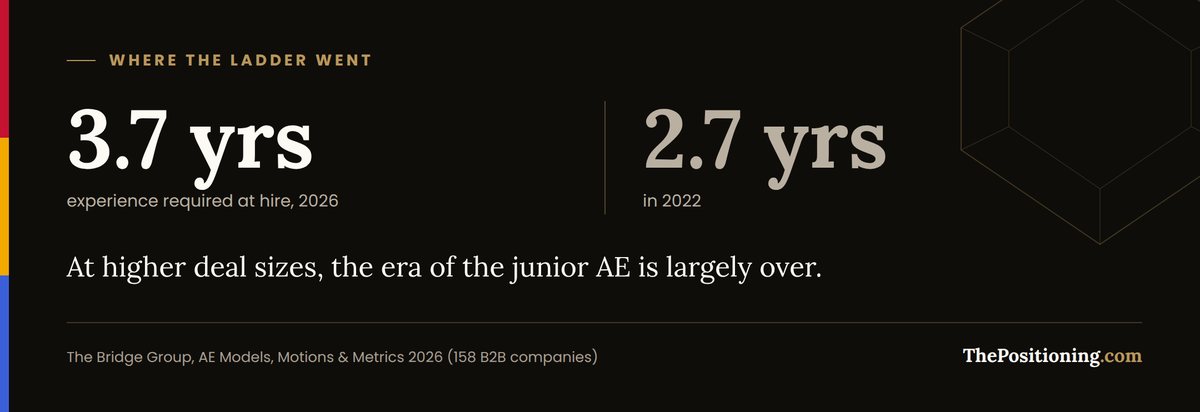
The final piece of evidence for this trend is that companies now require an additional year of previous work experience for Account Executives (AEs) compared to what they required just four years ago; according to The Bridge Group’s own blunt reading, the era of the junior AE is largely over at higher deal sizes.
At the company level the logic holds. Ramp time is increasing and becoming more costly, and quota attainment is decreasing, so companies de-risk by buying experience instead of building it. In addition, every single hiring manager who makes this decision is doing what they should do.
One more finding from the same study complicates the AI narrative in a useful way. Organizations in the top tercile of AI engagement reported 57% of reps at quota, against 39% in the bottom tercile. That’s an eighteen-point spread, and it’s observational rather than causal, as the authors are careful to say. But whichever direction the arrow runs, the correlation is now strong enough that “we’ll adopt AI selectively” is a position you have to defend rather than assume.
The skills market is pricing judgment, not tools
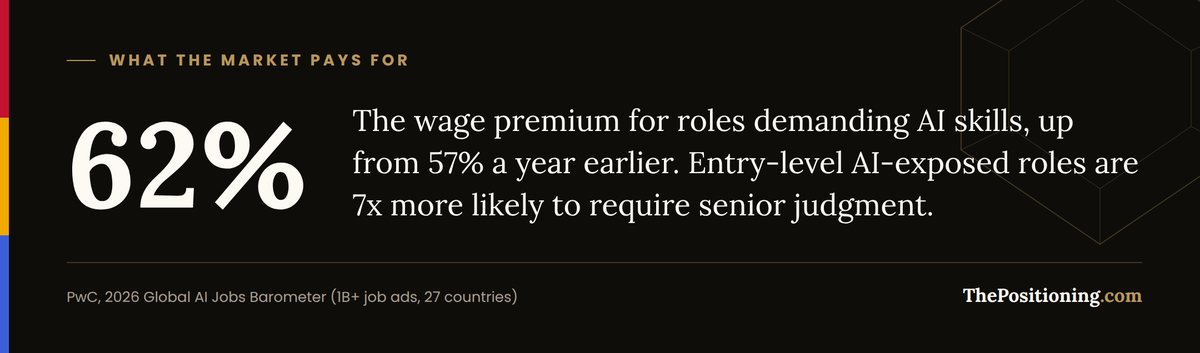
PwC’s 2026 Global AI Jobs Barometer (which scans over one billion job postings in 27 different countries) indicates that jobs requiring AI-related skills carry a wage premium of 62% – compared with 57% last year. A common reaction would be “Learn the Tools.”
However, this is an inadequate response; according to the same study, entry-level positions exposed to AI are now seven times as likely to require senior-level skills including judgment and leadership.
That is the actual repricing. As the tools become easier to use each quarter, the GTM Engineer data already shows employers are increasingly concerned with Clay rather than Python.
However, what is becoming increasingly costly is determining when a particular account requires a human interaction; when a specific deal will require a demonstration; and when an individual customer’s conversation cannot simply be put into a template.
Therefore, the premium does not relate to running the technology itself but rather to making decisions regarding how the technology will operate.
Where this data is thin, and where I’d be careful
Three honest caveats, because a hiring analysis that pretends to certainty isn’t worth acting on.
There’s no way to tell how many partnerships exist through the jobs posted online. All of the data comes from vendors who sell partnership management software, which gives them every reason to want to show that their products work well. My view is that partnerships are increasing at companies whose products are part of another company’s ecosystem and remaining constant at other types of companies, but I wouldn’t build a plan on the published figures.
Most of the AI-native comparisons are based on venture-backed portfolios. The ICONIQ portfolio does not represent a cross section of B2B software; rather, it represents a group of high-growth, well-capitalized organizations with different challenges than those faced by a small-to-medium sized ($30 million) independent (bootstrapped) organization located in the Midwest. While the trend line is correct, the magnitudes probably aren’t, for you.
Job postings indicate what a company wants to do, not what they have done. When a job is posted, it indicates that a company has identified a need for someone to fill a position. Many times positions are filled at less senior levels than originally advertised and many times jobs go unfilled.
We are automating the training ground
Here’s what ties the whole dataset together, and it’s the part nobody has solved. The SDR seat and the support queue were never only coverage; these positions were also a chance for new hires to develop skills through on-the-job training. It was during these times that a 23-year-old would learn what a true objection sounded like, why an upset customer was really upset, and when a sale fell apart.
Ultimately, these experiences produced the AEs, CSMs, and eventually the CROs.
We are cutting those seats while simultaneously demanding a full extra year of experience from AE candidates and raising the skill bar on entry-level roles sevenfold. Each decision is individually rational. Together, they remove the escalator.
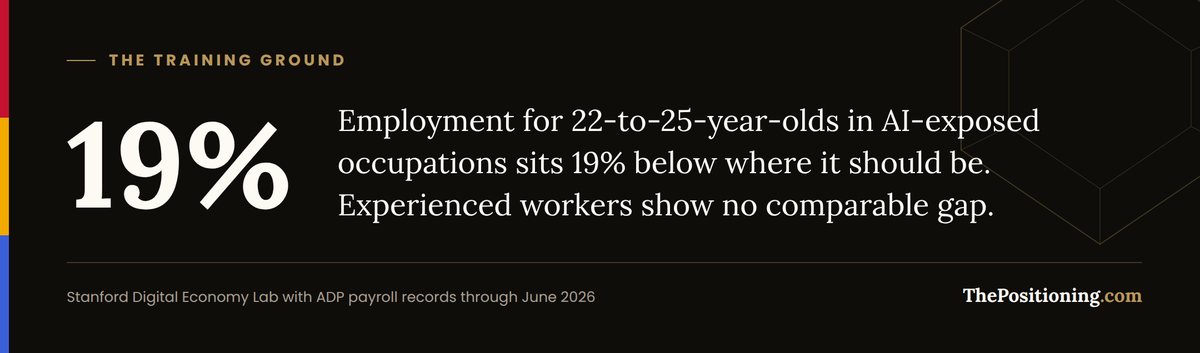
This is no longer speculation. Stanford’s Digital Economy Lab, working with ADP payroll records through June 2026, finds employment for 22 to 25 year olds in highly AI-exposed occupations sitting about 19% below where it would be had it tracked their less-exposed peers. Experienced workers show no comparable gap. Critically, the mechanism is reduced hiring rather than increased separations: companies aren’t firing juniors, they’re declining to add them. And the declines concentrate in occupations where AI substitutes for human work rather than complementing it, which is precisely the coverage-versus-leverage line drawn through the GTM org.
ICONIQ’s report contains the same behavior described from the employer’s side. Among the ways companies are funding AI experimentation without new headcount is a phrase worth reading twice: not backfilling junior attrition.
In four words, this is what it’s all about. No one had a meeting where they agreed to cease developing talent. Rather than continuing to replace employees at the lowest level of their organization for several quarters, they simply chose to leave positions unfilled. Each employee whose position was not filled resulted in cost savings and no apparent problems occurred.
However, something will ultimately fail; it will occur sometime around 2031. At that time, there will be no generation of workers capable of leading your enterprise sales teams and the few remaining experienced professionals will be sought after by all organizations that have made similar rational decisions regarding their own workforce development strategies.
Companies that succeed at this aren’t going to be those with the most advanced artificial intelligence (AI) technology; all companies should have access to adequate AI technology by 2028. Rather they’ll build back an apprentice system that was eliminated by the marketplace. This means allowing junior employees to work with senior salespeople on calls/emails/deals that could have been done by one person and viewing the time spent working together as a training expense versus a staffing issue.
In addition, the 2026 hiring data shows which positions can be cut but doesn’t indicate where your 2031 revenue leaders will come from. That answer isn’t in the job postings, because the jobs that used to produce them are being posted 21% less often. For what the same squeeze does to marketing careers specifically, see The Career Ladder Is Still on the Org Chart. The Climb Isn’t..
Sources: Sumble job-post data via Kyle Poyar, Growth Unhinged, H1 2026 State of GTM Hiring (22,988 US B2B GTM posts, Q1 2026); ICONIQ, Building the Modern GTM Org 2026 (150+ GTM leaders); The Bridge Group, AE Models, Motions & Metrics 2026 (158 B2B companies); Emergence Capital and Benchmarkit, Beyond Benchmarks 2025 (560+ companies); Indeed postings index via Business Insider; Robert Half, 2026 Demand for Skilled Talent; PwC, 2026 Global AI Jobs Barometer; Stanford Digital Economy Lab, Canaries in the Coal Mine (ADP payroll records through June 2026).
AI was used in research and formatting.

Written by
Ryan Frazier
He’s spent 18 years building and leading marketing teams, from Series A startups to multi-billion-dollar public companies — four of them scaled past the $50M, $100M and $250M ARR marks, and all four through to acquisition. He writes The Positioning, on why winning has less to do with being right than with being well-positioned at the convergence of time, place, and resource.
More about Ryan →