How to Write a Positioning Statement Your Reps Can Actually Sell

Most teams treat the positioning statement as the finish line. Product marketing runs the workshop, fills in Geoffrey Moore’s template, gets sign-off and ships it to sales. Then comes the follow-up April Dunford describes hearing from clients: “marketing’s all happy but sales don’t know what to do with this.”
In many cases, the words fail before a sales rep even opens their mouth. Wynter stripped the brand names from five real CRM value propositions and asked 100 B2B marketing leaders to match each one to its vendor. The average score was 1.86 out of five (1.0 = random guessing).
The problem is not copy. The problem is structure. A positioning statement is a sales tool that happens to live in a strategy deck. If a sales rep can’t say it, can’t prove it, and can’t use it to beat the ‘do nothing’ alternative on a live call then it is not finished, no matter how good it looks on paper. The deck is not the test. The call is.
The Moore template was built for the boardroom, not the call
The template most teams still use comes from Moore’s Crossing the Chasm. As TechTarget lays it out, it runs “For (target customer) who (statement of the need or opportunity), the (product name) is a (product category) that…” and goes on to name the key benefit, the primary competitive alternative and how the product differs from it.
As a thinking tool, it works: it forces a team to pick a customer, a category and a rival. The trouble starts when the sentence is all that’s left. Dunford made the case in Hackernoon back in 2016: the exercise produces “an awkward franken-statement of gobbledygook,” and it “gives you the false sense that you are ‘done’ doing positioning.”
That false finish is the expensive part. Sign-off feels like completion, so nobody checks whether the statement works in the room where revenue gets decided. In the same 2023 conversation with Will Critchlow, Dunford named the failure plainly: ‘Sales intellectually understands the positioning, they just don’t know how to pitch it.’
This is something that I have experienced myself. A few years ago we were positioning a SaaS product that was not the cheapest on the market. We had a lot of user data and based on that data the platform had dozens of features but only 2 of those were really being used by our customers. So we told our reps to lead with those 2 features and try to get prospects to imagine how they would use them to improve their own workflows and increase productivity.
Reps sold the volume of features and continued to add sideline capabilities in a long, disjointed sales pitch that didn’t hit on the main value that the prospect was looking for.
I tried to explain the strategic thinking behind our positioning. However, I hadn’t translated that into something that a sales rep would choose to use in place of a long list of features and benefits when a prospect goes silent on the call. If the rep’s default is to read off the inventory, then our statement must give them a better default.
Buyers can’t tell your statement from your competitor’s
Wynter’s B2B Vendor Differentiation Survey, conducted in June 2026, tested 5 value propositions from Salesforce (Agentforce), HubSpot, Zoho, Pipedrive and Oracle in an unedited, real state and with the vendor name removed from each. The average number of correct answers was 1.86. CMOs and chief marketers fared even worse at 1.70. 43% of all respondents scored zero or one.
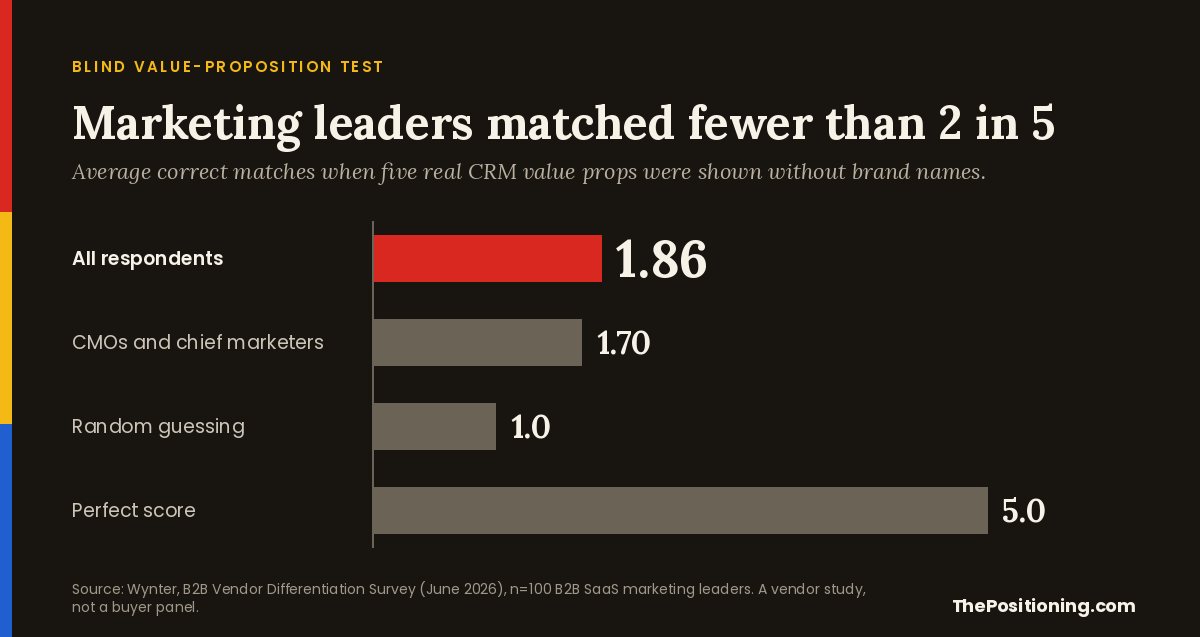
First, there are 2 caveats on this data: the respondents were 100 B2B SaaS marketing leaders, not a buyer panel, and this is the study of one vendor. On the other hand, these people write value propositions for a living and even they couldn’t tell the 5 biggest CRM brands apart. If the category leaders can’t tell them apart, neither can the buyers.
We also asked the category leaders about their own experience comparing vendors. 61% said they often or constantly thought, “these all basically do the same thing.”
If the leaders of a category of product or service say that they all basically do the same thing, then your statement is likely to be similar to theirs. All the teams in a category of product or service use the same research to fill in the blanks of a sentence and use different nouns.
Your real competitor is the buyer doing nothing
The “unlike” slot in most positioning statements holds a named rival, the competitor the team watches most closely. It often isn’t the one that kills the deal.
Matt Dixon, whose team analyzed about 2.5 million recorded sales conversations, told CustomerThink in 2022 that “anywhere between 40 and 60% of all deals are actually lost to the customer doing nothing.” This number comes from an interview with the author of the research, not from the book itself. More importantly, preference for the status quo accounts for less than half of the losses. Buyers are “worried about making a big mistake” and need reassurance that the purchase is correct.
There is a difference between trying to beat a named competitor in a comparison problem and trying to beat “doing nothing” in a confidence problem where the prospect needs a reason to act now and to be assured that doing so is safe. A value proposition that only compares your solution to your competitors’ gives your rep nothing to sell when the deal falls apart because no one wants to make a decision.
The wording in Moore’s statement is “primary competitive alternative”. The status quo can be considered a “primary competitive alternative” but most teams do not include it in their value propositions. This is why the above statement was written for the boardroom and not for the buyer.
The deal is decided on the floor, not on the homepage
When Wynter asked the same marketing leaders what made the vendor they ultimately chose different from the rest of their shortlist, the top answers had little to do with written messaging. Fit to use case and stack came first at 32%, then the sales experience at 31%, third-party validation at 27%, tangible proof points at 18%, and trials and POCs at 11%. Answers were open-ended and coded, so one response could count toward several themes.
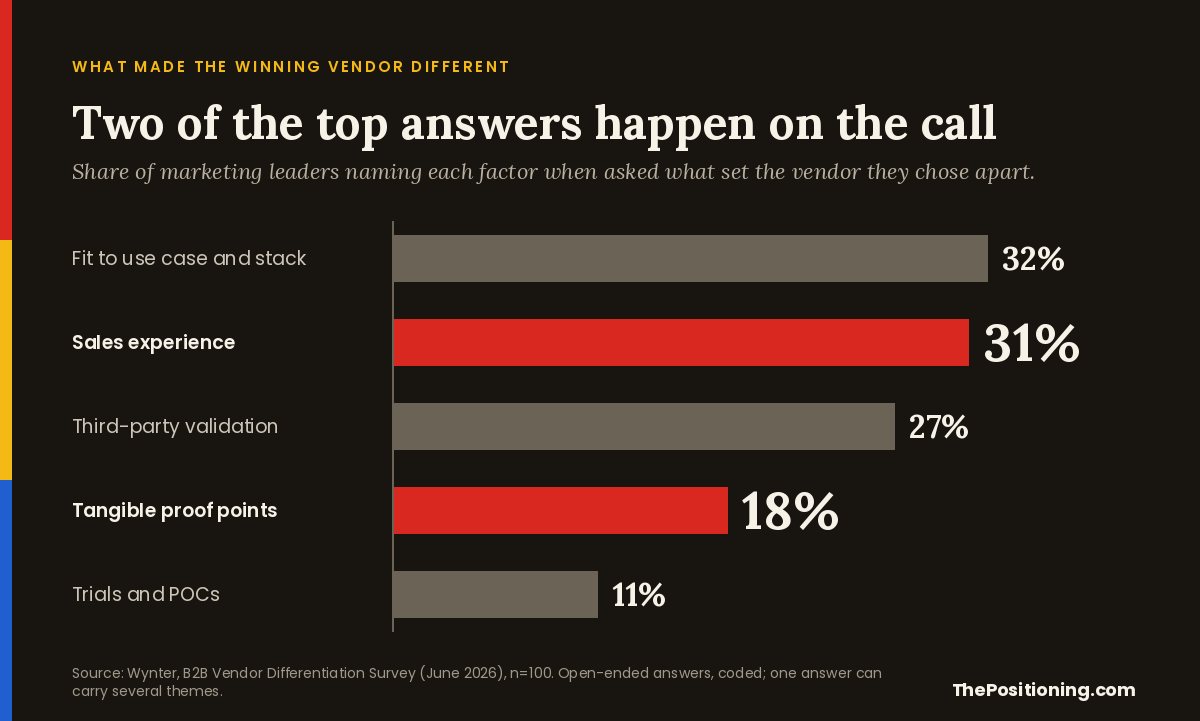
The vendor’s differentiation was proven in the process of evaluating the vendor’s offerings. When a vendor made the shortlist, only 37% of the time did the buyer choose the vendor based on a clear product difference. The other 63% of the time, something else was the deciding factor. It was the statement that the vendor’s rep could show that won the deal, not the statement itself.
Then the message has to survive the handoff, and often it doesn’t. Gartner’s survey of 632 B2B buyers, run in August and September 2024 and released in June 2025, found that 69% reported inconsistencies between a vendor’s website and what its sellers told them. The same survey found 61% prefer a rep-free buying experience overall, which makes the rep conversations buyers do accept count for more.
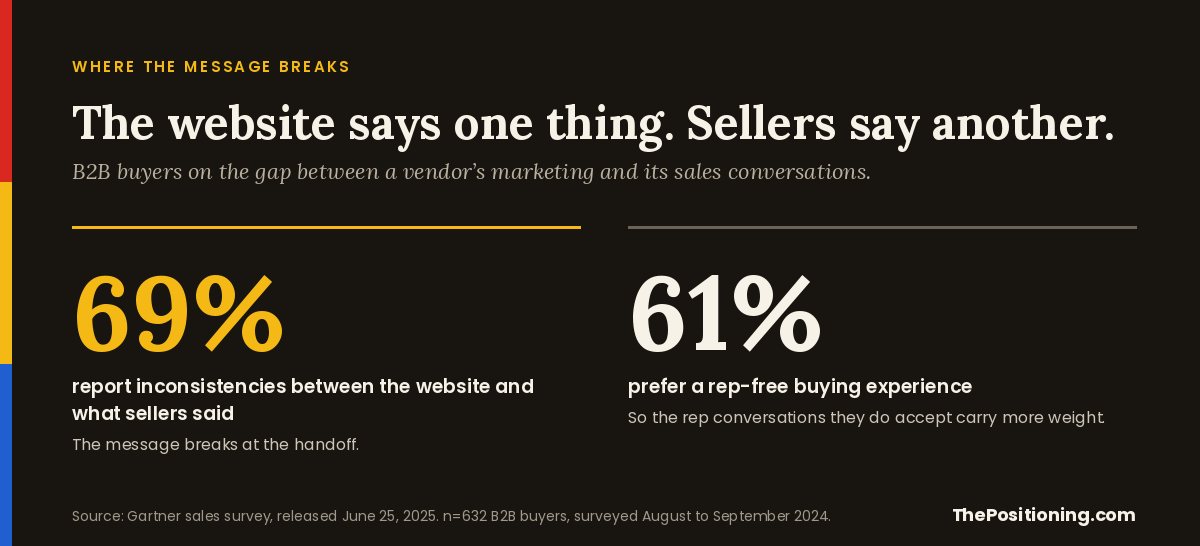
That 69% gets filed as a sales enablement problem, and it is one. But it starts with the statement. If the sentence marketing ships can’t be said out loud, reps improvise, and no two reps improvise the same way. Inconsistency is the predictable outcome of an un-sayable statement.
Write it in the rep’s grammar, then translate it for the deck
Instead of using Moore’s slots for the deck first, use the reverse order. First write out what you think the rep would say, test it on the floor, and then reverse the order to use Moore’s slots for the deck. The template becomes the record of a statement that works.
This is the test that I use to see if a statement is ready for the deck. It consists of 4 parts and the statement must pass all 4 parts before it can be used on the deck.
Alternative: This is the thing(s) that the buyer would do instead of purchasing your solution. This can include doing nothing. If the only alternative on the page is a competitor then this fails. The buyer has more options than the ones listed on the competitive landscape slide.
Edge: It’s what you do that no one else does. Name one thing only you do. The two-tool story above is a failure on the Edge test. It’s a list of dozens of features that the rep can use as an inventory to recite but there’s no argument. One edge forces a choice. A list of features avoids one.
Proof: The rep can prove the Edge in five minutes or less. This could be a demo moment, a number or a customer reference. Wynter’s data points to proof points as being most important in the sales experience of the winners. If you can’t prove the Edge in five minutes, you don’t have it yet.
Cost of waiting: This is the reason the buyer should buy now instead of continuing to do what they are doing. This answers the buyer’s fear of making a mistake, as described by Dixon. If there is no cost to waiting, then there is no urgency to buy. No urgency to buy, no decision to buy.
Here’s an example of how this would play out on a contract-review product for in-house legal teams. The template version of the above: “For in-house legal teams who need to manage growing contract volume, [Product] is an AI-powered contract lifecycle platform that streamlines review and improves collaboration. Unlike legacy CLM tools, [Product] offers an intuitive, all-in-one experience.”
This fails on all four parts. There are a class of rivals, but no specific competitors are named. It’s a feature list of features that are already on the page. There is no proof, and no reason for the buyer to purchase this quarter. It’s a brand review statement, but it would fail on the first call.
The rep’s version of the above: “Right now your team reads every NDA line by line or sends it to outside counsel. We flag the clauses that break your playbook before a lawyer opens the file, and I can show you that on one of your own NDAs in five minutes. Every month you wait, [hours from your own customer data] of attorney time go to documents nobody needed to read closely.”
The alternative is the way the buyer is currently doing things. The Edge is one sentence. The proof can be demonstrated on the buyer’s own paper in five minutes or less. The cost of waiting can be checked by the buyer against their own data from other customers. No adjectives required.
Once it passes, translate it back into the template for the deck, then build the rest of the message on top of it. The Messaging Framework covers how to carry one statement into pillars and proof by audience.
Intercom shows what a sellable positioning looks like
Intercom rebuilt its positioning around Fin, its AI agent. According to Lenny’s Newsletter’s summary of its August 2025 episode with CEO Eoghan McCabe, the company “pivoted to become an AI-first company,” with a working prototype of Fin within six weeks of ChatGPT’s launch. Pricing moved to $0.99 per resolved ticket.
That price is the positioning made provable. A rep doesn’t have to argue that Fin is different from every other support bot, because the claim is billed on the outcome: the buyer pays when a ticket gets resolved. The edge and the proof collapse into a single unit, and the alternative (people handling every ticket) is implied in every invoice. That’s what a statement that passes the Floor Test looks like in pricing.
Sacra estimates that Fin has passed $100M in ARR, is growing about 350% a year, and that the shift to outcome-based pricing moved net revenue retention from 112% to 146%. Those are third-party estimates rather than company-reported figures, so read them as directional.
Gong made a related move at the level of the frame. In a Tofu write-up of an AMA with Gong’s Udi Ledergor, the “revenue intelligence” label is explained as the one that fit Gong’s vision of a product for CROs, and its ambition to do more than record sales calls. A call recorder gets compared feature by feature with other recorders; a revenue intelligence platform gets bought by the person who owns the number. That frame-of-reference choice, covered in how to claim a category and defend it, sits upstream of every statement. Pick the right frame and the statement gets easier. Pick the wrong one and no statement will save it.
Run the Floor Test before you ship
Three cheap checks, run before the statement goes into enablement. None of them require a budget line.
Start with call recordings. Pull a handful of recent calls and listen to the first five minutes. Mark where reps name the alternative, the edge, the proof and the reason to act. The gaps show which part of the statement never made it out of the deck. If your best rep’s phrasing beats yours, take it. The floor is right.

Have the team practice pitching the new statement to each other in a ‘pitch off’. They can test out different objections, value propositions and messaging to try and sell the product. Other reps can watch and then the whole team can vote on who did the best job of selling the product. There could be some prizes for the winner too.
To test a new statement under the pressure of the Floor Test, have one rep play the buyer who would rather do nothing. If the winning rep’s pitch can hold to the new statement, then that statement is effective. If the winning rep had to abandon the new statement in order to win, then the statement lost, not the rep.
Review closed-lost and stalled deals from the last two quarters. If a large number of deals were no decision, and the statement is only naming a competitor, then you need to fix the Alternative and Cost of waiting parts. If the deals went to a competitor then the reps had a proof moment for the edge, but only a claim. Claims don’t beat demos.
If a statement fails any of these three tests, then it goes back for a rewrite. It does not go into the enablement deck to be revisited later.
A statement that survives the floor can still be the wrong one
The Floor Test checks whether a statement can be sold. It doesn’t check whether the strategy behind it is right. A rep can say, prove and close with a statement that targets the wrong segment, or that puts the product in a category where it will always look small. Passing the test then just means losing more efficiently.
Which customers, which category and which alternatives matter are decisions that come first, in the kind of process laid out in the Ultimate Positioning Playbook. Dunford’s point holds here too: positioning “cannot be a ‘one and done’ exercise,” and a statement is only as good as the positioning it compresses.
Nor is this an argument for letting sales write positioning. Reps optimize for the deal in front of them, and spaghetti at the wall was their instinct in my own story. The test asks sales to carry the statement, not to author it. Authorship still sits with product marketing. Proof sits on the floor.
Keep Moore’s template. Fill it in after the pitch off, using the words that won. That’s the sequence that makes the template useful again.
Sources: Wynter, B2B Vendor Differentiation Survey (June 2026, n=100 B2B SaaS marketing leaders); Gartner, “Gartner Sales Survey Finds 61% of B2B Buyers Prefer a Rep-Free Buying Experience” (press release, June 25, 2025; n=632 B2B buyers, Aug–Sep 2024); Matt Dixon interview, CustomerThink (October 12, 2022); April Dunford, “Obviously Awesome: A Product Positioning Exercise,” Hackernoon (November 7, 2016); April Dunford on Business Class Lounge with Will Critchlow, SearchPilot (March 16, 2023); Ivy Wigmore, “Positioning statement,” TechTarget (December 22, 2020), citing Geoffrey Moore, Crossing the Chasm; Lenny’s Newsletter, “How Intercom rose from the ashes,” episode summary (August 21, 2025); Sacra, Intercom company profile (estimates, 2026); Tofu, “Udi Ledergor AMA: Creating New Categories with Gong” (updated April 13, 2026).
AI was used in research and formatting.

Written by
Ryan Frazier
He’s spent 18 years building and leading marketing teams, from Series A startups to multi-billion-dollar public companies — four of them scaled past the $50M, $100M and $250M ARR marks, and all four through to acquisition. He writes The Positioning, on why winning has less to do with being right than with being well-positioned at the convergence of time, place, and resource.
More about Ryan →