How to Write a Brand Platform That Settles Arguments Outside Marketing
The typical story of a rebrand includes the agency presenting the book to the company, the CEO walking the company through the book at an all-hands meeting and the company leaving aligned. A quarter later, the only people opening the book are the designers.
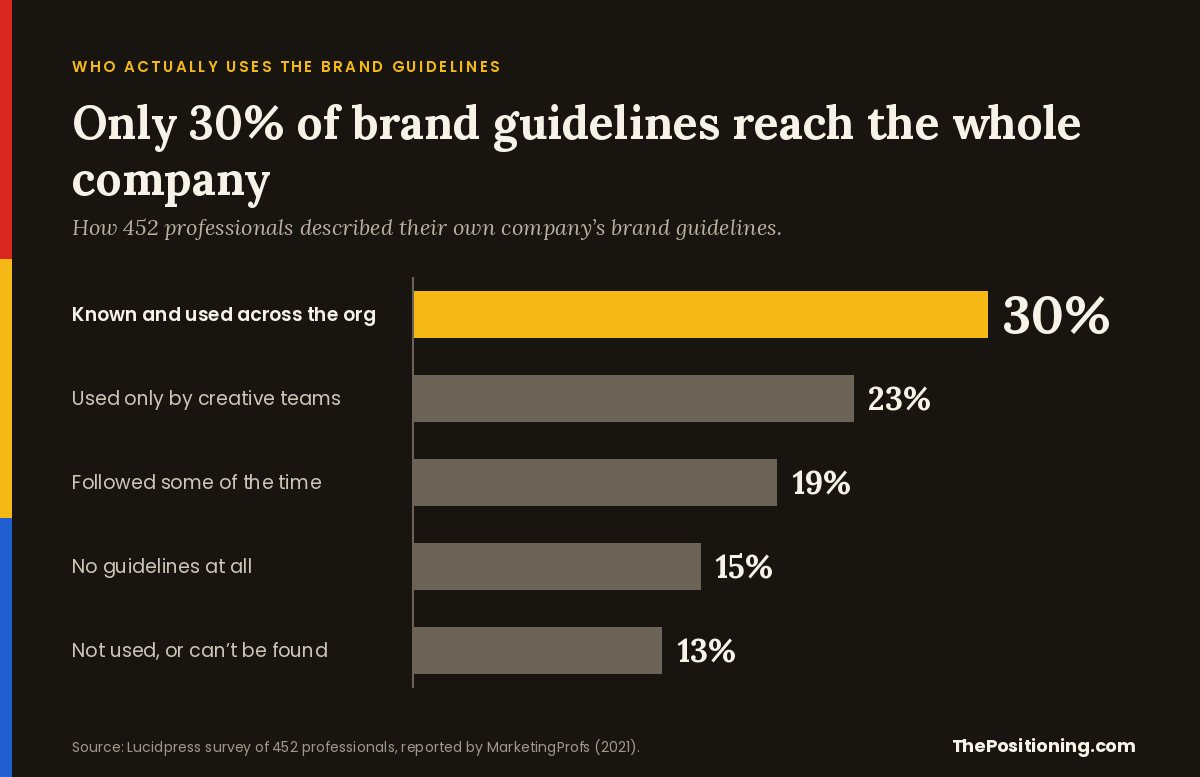
The data backs the cynics. In a Lucidpress survey of 452 professionals reported by MarketingProfs in 2021, only 30% said their brand guidelines are “well known and used by most of the organization.” Another 23% said only their creative teams use them. My claim is simple: a brand platform is real only if people outside marketing use it to settle disputes. Most platforms fail because they describe the brand to designers, when what the company needed was a set of rules for making decisions. A book that only designers use is not a platform. It’s a style guide with ambition.
Most brand platforms are written for the design team and nobody else
Most of the content in brand books is aimed at answering the questions of designers. For example, a page on logo clear space, a palette with hex values, a type hierarchy, a page of photography mood shots and a page of adjectives. There is almost nothing in a brand book that answers the questions of a sales rep or a support lead on a normal Tuesday. So the book finds its audience, and that audience is small. The rest of the Lucidpress numbers fill in the picture. Another 19% say their guidelines are followed some of the time, 13% say they aren’t used or can’t be found, and 15% say their business has no guidelines at all. Nearly everyone in the sample (92%) uses creative templates, but only 16% say those templates are used across the entire organization. And 77% say off-brand content gets created at least a few times a year.
Off-brand content is the symptom people complain about. The cause is upstream: the platform was written for the one team that already understood the brand. That’s not a compliance problem. It’s a usefulness problem.
An identity guide governs how you look, and a platform governs what you do
These two documents are often bundled together and treated as one by many companies. They serve very different purposes. The visual identity guide outlines the execution of the visual elements (where the logo sits, which blue to use, which typeface to use etc.). The platform, on the other hand, outlines the choices that can be made in terms of customers to pursue, promises to make and what to decline. If the platform is contained within the identity guide then it will inherit the audience of the identity guide. A platform nobody outside marketing reads is where the gap between brand identity and brand image starts — the place where what you say you are and what the customer experiences diverge.
You can see the cost in who understands the brand. In Gallup’s 2012 study of more than 3,000 US workers, 41% strongly agreed with the statement “I know what my company stands for and what makes our brand(s) different from our competitors.” Executives understand the brand better than managers, who understand the brand better than other employees. (60% vs. 46% vs. 37% respectively, based on 14 year old data from Gallup, which I can’t find a more recent cut of). Understanding of the brand thins out as you move further away from the room where it was written.
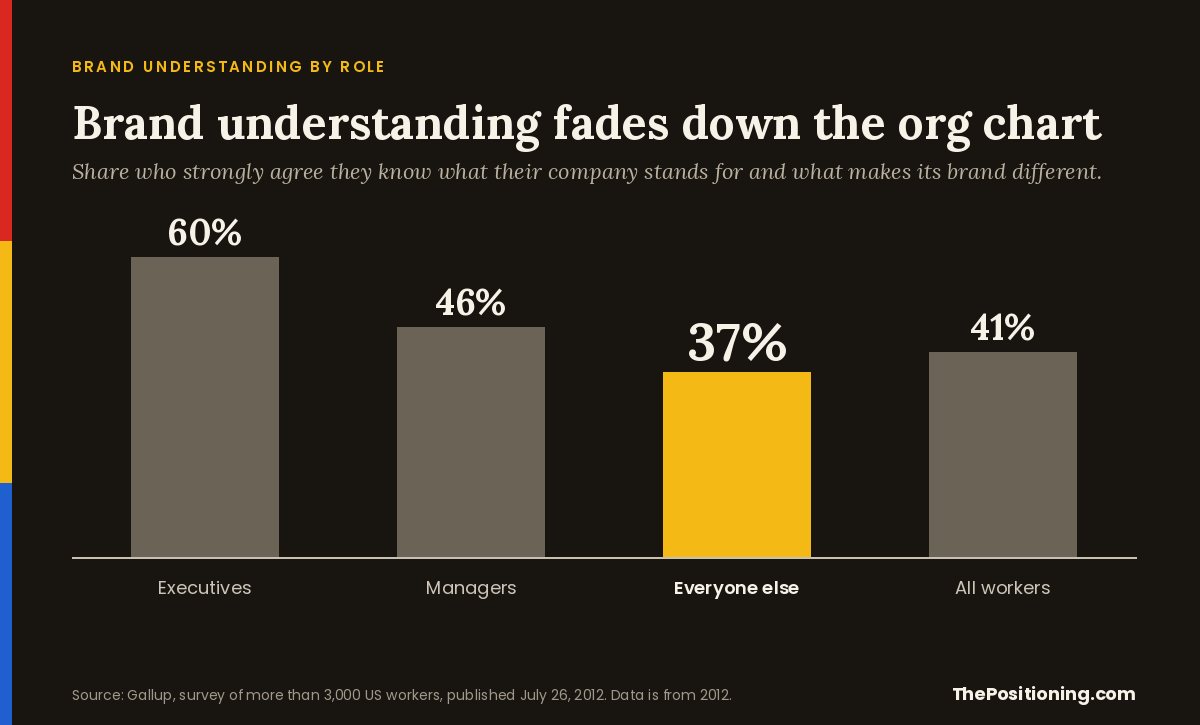
That 37% is the group answering the phones and negotiating the contracts. They make more brand decisions in a week than the brand team makes in a quarter, and they’re working from the thinnest version of the brand. That’s where brand equity actually gets spent.
The test of a platform is whether it can settle an argument
This is the standard I’d hold a platform to. If two smart people within a company can’t settle a disagreement by opening up the platform to the rest of the company, then all you have is a mood board with a mission statement on top. Patagonia is the clearest public example. Its stated purpose is “We’re in business to save our home planet,” and its core values include “Build the best product” and “Not bound by convention.” On Black Friday in 2011, the company ran an ad in the New York Times telling readers “Don’t Buy This Jacket.” Its reasoning: “It would be hypocritical for us to work for environmental change without encouraging customers to think before they buy.” A retailer telling people not to buy on Black Friday has made a revenue decision, and the platform is what made it possible to make it quickly.
This is the less well known version of the scenario described above. I had a client in the business of assisting universities in launching new programs of study. The stated mission of the company was to assist students in attaining the skills and knowledge required to achieve their goals and build careers. At the time of my involvement with the company, it was heavily contracted to some unaccredited universities and trade schools. The placement rates and job attainment rates of the students in these programs were questionable at best. The contracts with these universities were revenue for the company and the owners of the company had reasons to protect these contracts. The company in question adhered to its stated brand focus of serving students, stating that it would only work with providers that could prove that their programs delivered value to students in terms of both learning and job placement. The mission was not just words on the wall, it was the tiebreaker.
Look at what did the work in both cases. The mission named who the company served, and that turned a commercial argument into a question with an answer. Neither platform needed to be clever. Each one needed to be specific enough that someone could point at it in a meeting and say ‘this is why we don’t do that.’
Every part of the platform should name the decision it settles
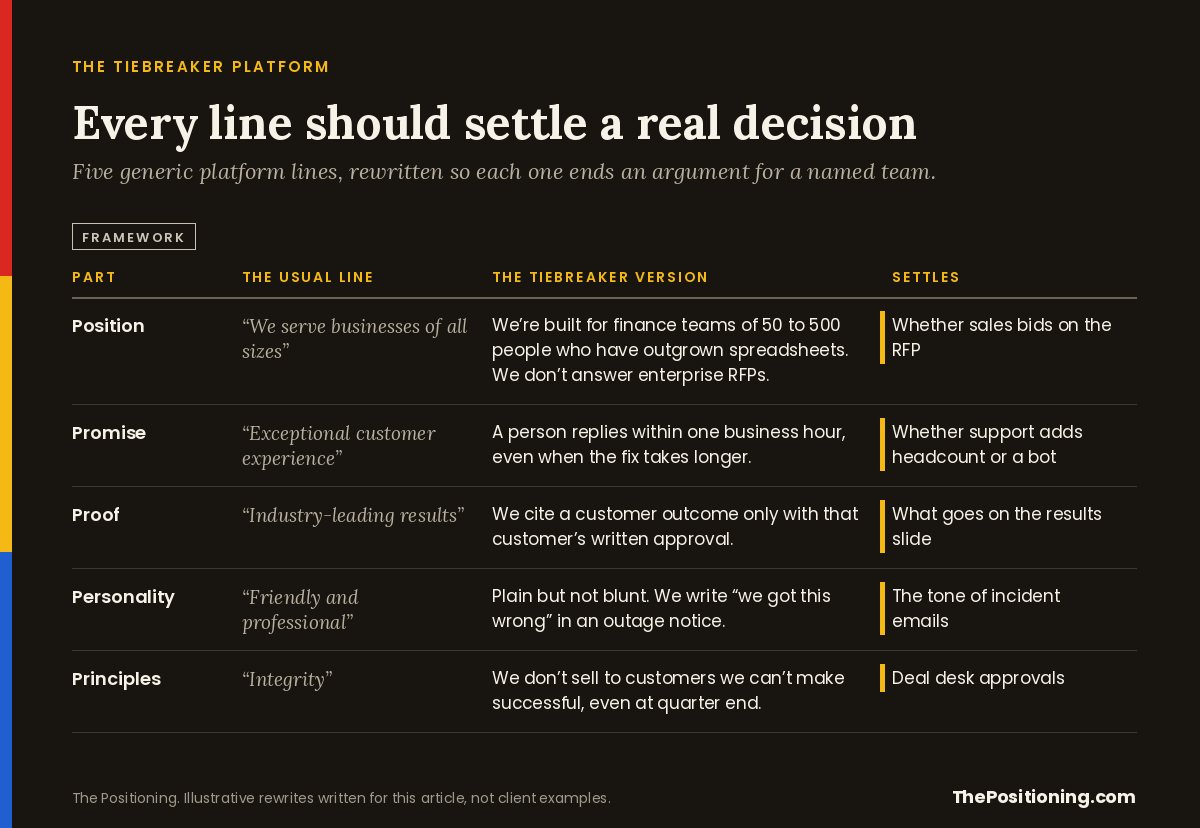
I use the Tiebreaker Platform, a 5 part framework with one test per line. It names the decision being made and the person making that decision. If a line cannot name both, then it is cut from the list. “We’re innovative” never solved anything.
Position is who we’re for and who we’re against. It settles which deals, segments and features the company chases, and sales and product are the people who use it. The messaging framework templates cover how to write the positioning statement underneath it.
Promise is the one thing every customer can count on. It settles the trade-offs between speed, price and quality that ops and support face every day. If you promise two things, you promise nothing.
Proof is the evidence the company is allowed to cite. It settles which claims make it into decks and ads, which is why sales, PR and legal all need it. Proof is the part that keeps you out of trouble.
Personality is voice, written as “X but not Y” pairs with examples. It settles how the company sounds in an error message, an apology or a price increase, and it belongs to anyone who writes. Not just marketing.
Principles are two to four values phrased as rules. They settle what the company refuses to do even when it would make money. Leadership owns them, because leadership is who gets tested when the revenue is on the table.
“We’re innovative” fails the test, because nobody has ever lost an argument to it. The visual identity guide sits beside all five parts and stays out of them. It governs execution, and the platform governs choices. Mix them and you get a beautiful book nobody can use.
Voice only works when people get examples they can copy
Personality is the part most platforms get wrong, because adjectives don’t transfer. Tell a support agent the brand is “friendly but expert” and you’ve given them nothing they can type on a Tuesday.
Mailchimp’s voice and tone guide is the model most writers know. The first part of this section identifies what remains constant (your “voice”) versus what changes (“tone”). It then defines the voice through paired descriptions such as “we are strange but not offensive,” “intelligent but not elitist.” This latter part of each description is where the actual definition occurs, because it establishes the boundaries of the voice.
Monzo pushed the voice further into the company. The bank published its tone of voice guide in March 2018. A year later, Monzo writer Harry Ashbridge reported that “well over 700 Monzonauts” had attended its writing training. Every new joiner got an introduction to the writing approach during onboarding. The writers were embedded in the cross-functional squads that are building features and the company has a jargon tracker where staff can log the terms they do not understand. Monzo put the voice where people are already working and checked whether it worked for them. That is the difference between a guide and a habit.
When the platform isn’t where the work happens, people write their own
People don’t stop needing guidance when the official platform fails them. They make their own. In a 2021 survey from Frontify, a company that sells brand management software, 67% of more than 750 brand, marketing and design leaders said they create their own set of guidelines separate from the official company format. Nearly all the C-level respondents (98%) said their company would benefit from one central set. Upwave ran the fieldwork.
Approved material shows the same pattern. Templafy, which sells template and document software, surveyed 2,296 employees at companies of 1,000 or more people in the UK, US, Germany and Australia between December 2021 and January 2022. 73% of those surveyed don’t use the latest company-approved version of materials, 26% of the people surveyed create materials from scratch, and 69% of those surveyed use Google to search for company assets. Both are vendor surveys for the respective companies’ products that fix these problems. Thus, read the exact percentages with caution. The general direction of the findings however matches those of the independent Lucidpress and Gallup studies as well as what sales teams typically include in their slide decks: They are building a shadow version of the official version of materials.
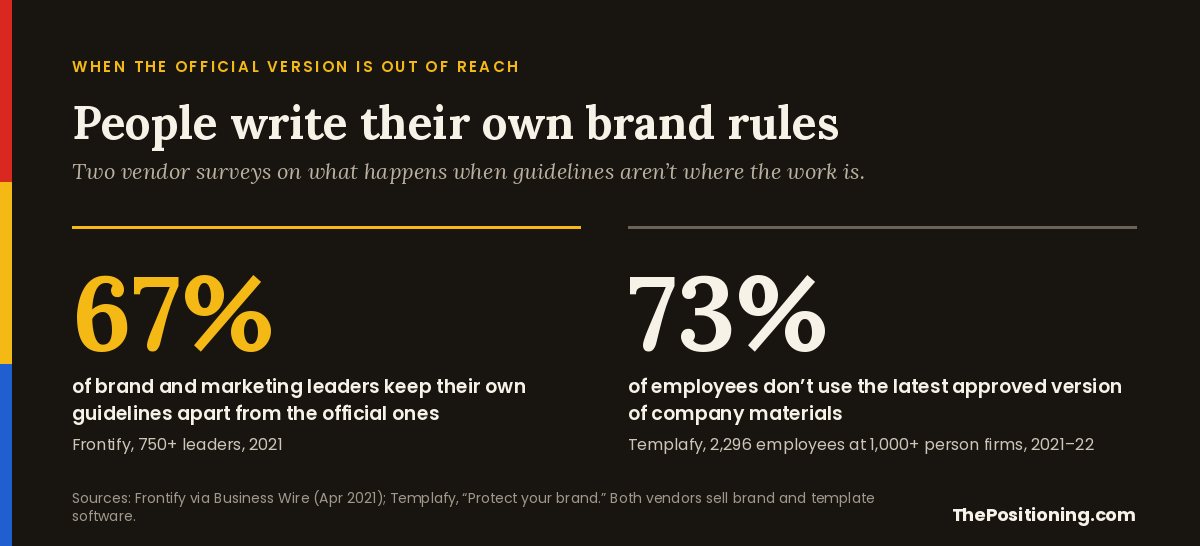
Shadow guidelines are the employees’ verdict on the official ones. This is the daily, unglamorous side of brand culture. What a company actually stands for gets decided by whatever people can find when they need it. Not what’s in the book. What’s on the drive.
Write it with the people who will break it
Start by collecting real disputes. Interview a few people in sales, support and product, and ask for arguments they’ve had in the last six months: the deal someone wanted to walk away from, the feature that got cut, the refund that got escalated. Ten real disputes will teach you more than a hundred adjectives. Adjectives never argued with anyone.

Then write against them. Write each of the Tiebreaker sections and run the disputes through them. If a dispute doesn’t get resolved then there is a hole in the platform. If a line is never used then delete it. Does it resolve anything for anyone? Test the Tiebreaker document with the people who will be using it. Send a sales lead and a support lead a copy of the Tiebreaker and ask them to use it to resolve two disputes. Note where they have to look outside the Tiebreaker to find the information they need to resolve the dispute. That is where the platform is missing.
Place the brand platform in the core GTM collateral kit, in front of the material sales and customer teams who are looking at collateral on a daily basis. We also have a public mission statement that we can use to communicate our goals and convictions to our prospects. It builds trust with our customers, and allows them to hold us accountable.
By making the commitment to customers public, you change the internal incentives. Now, when people argue about whether to bend the brand, customers are in the room. A decision tool can be created in two weeks. This is not a six-month rebrand project.
A platform can’t make a strategy decision you’ve been avoiding
The Tiebreaker Platform settles arguments inside a strategy. It can’t supply one. If leadership hasn’t decided whether the company is moving upmarket, no Position line will settle the enterprise RFP fight, and a vague one only moves the argument into the document. A platform inherits whatever clarity the business strategy has, which is why brand strategy has to solve business problems before the platform can do its job.
It also can’t be finished. GOV.UK’s content designers put it plainly in a 2014 post on how they work: “You – our users – inform our style guide. That’s why our style guide is ever-changing.” A platform written once and laminated starts drifting with the first new segment or price change. Plan revisions the way you plan product releases. Version it.
While a platform can help in many cases, it won’t win every argument. Patagonia lost sales on a specific day because its leadership chose to adhere to its principles. My client walked away from contracts because the student in the company chose the student over the revenue. A good platform can give those who want to hold the line something to point to. But whether or not anyone supports them is not a decision that a document can make for you. The whistle doesn’t blow itself.
Sources: Lucidpress survey via MarketingProfs, “Are Businesses Creating and Using Brand Guidelines?” (2021); Gallup Business Journal, John H. Fleming and Dan Witters, “Your Employees Don’t ‘Get’ Your Brand” (July 26, 2012); Patagonia, “Our Mission”; Patagonia, “Don’t Buy This Jacket, Black Friday and the New York Times” (Nov 25, 2011); Mailchimp Content Style Guide, “Voice and Tone”; Monzo, Harry Ashbridge, tone of voice anniversary post (Mar 27, 2019); Frontify, State of Brand Ownership, via Business Wire (Apr 22, 2021); Templafy, “Protect your brand” report (fieldwork Dec 2021–Jan 2022); GOV.UK Government Digital Service blog, Carrie Barclay and Giles Turnbull (June 13, 2014).
AI was used in research and formatting.

Written by
Ryan Frazier
He’s spent 18 years building and leading marketing teams, from Series A startups to multi-billion-dollar public companies — four of them scaled past the $50M, $100M and $250M ARR marks, and all four through to acquisition. He writes The Positioning, on why winning has less to do with being right than with being well-positioned at the convergence of time, place, and resource.
More about Ryan →