Inflation Taught Customers to Read Prices. Pricing Strategy Has to Catch Up
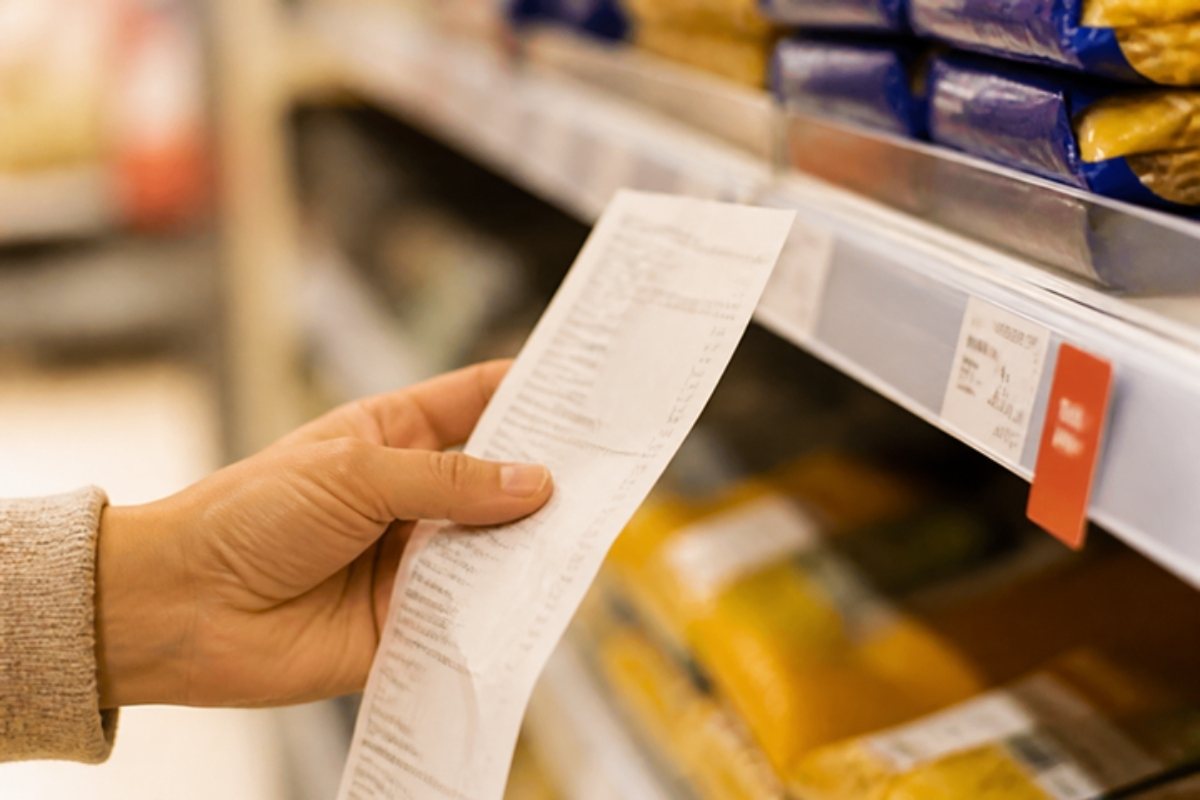
Many pricing teams are currently operating under the assumption that after a spike in inflation, inflation has cooled off and annual list-price increases can resume. But in February 2026, PepsiCo dropped prices for products like Lay’s, Doritos, Cheetos and Tostitos by up to almost 15%. According to Rachel Ferdinando, CEO of PepsiCo Foods U.S., consumers “told us they’re feeling the strain.”
By that time grocery inflation was low, so the rate of inflation was not the problem. PepsiCo’s buyers had learned to do the arithmetic on the price level, and it had stopped working in PepsiCo’s favor.
Price sensitivity has outlasted inflation and will not disappear after the next good CPI print. Five years of visible price increases have enabled buyers to check prices, compare and walk away. Brands that continued to grow on price alone have spent 2024 to 2026 handing it back. Pricing strategy needs to recognize that buyers’ ability to check, compare and walk away is here to stay and that each price must be defended with verifiable facts.
The rate cooled and the price level stayed
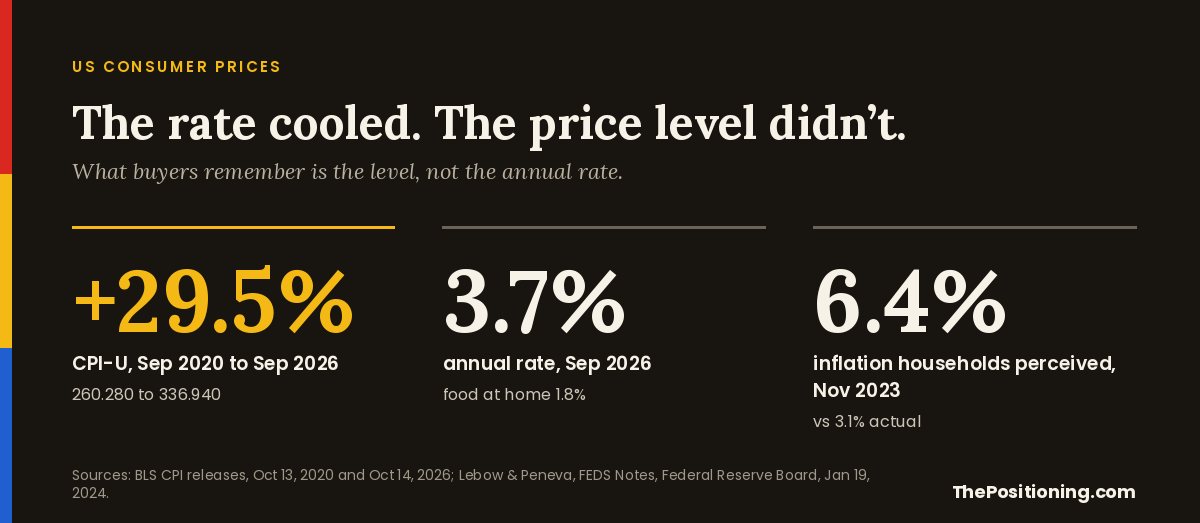
Start with the number that gets lost in the monthly headlines. In September 2020, the CPI-U index sat at 260.280. In September 2026 it reached 336.940. That is about 29.5% more for the same basket in six years.
The annual rate for all items was 3.7% in September 2026, while the rate for food at home was 1.8%. That would mean that by the measure economists and earnings calls watch, food inflation is near to being under control.
Buyers don’t read that measure. A Federal Reserve FEDS Note by Lebow and Peneva found that in November 2023 the median household perceived 6.4% inflation over the prior year, against a 3.1% change in headline CPI. Their explanation is the one every pricing leader should pin above the desk: “while the rate of inflation has come down, people are not seeing and hearing about declines in the level of prices.”
The pain didn’t end when the rate came down. In October 2025, the University of Michigan Surveys of Consumers reported that about 45% of consumers said high prices had eroded their personal finances, with the sentiment index at 53.6 against 70.5 a year earlier. If you read sentiment as a planning input, and you should, the case for doing so is in consumer confidence as a strategic signal. The signal here is not subtle.
Buyers measure against the price they remember
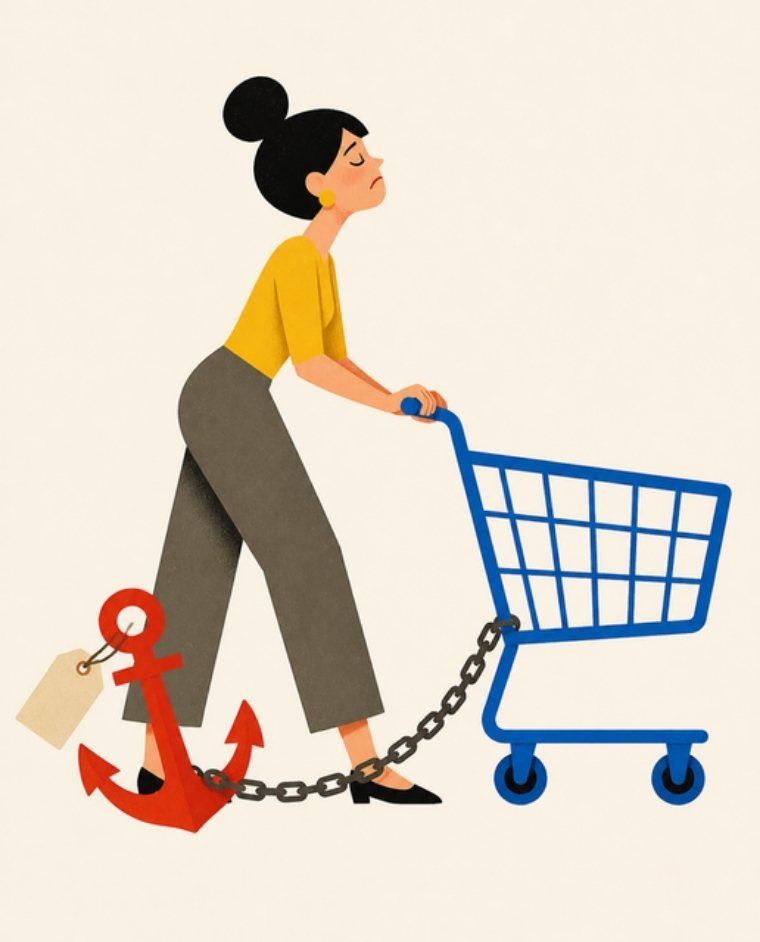
The mistake stems from the assumption that the customer will compare this year’s prices to last year’s. They compare this year’s prices to what they remember paying before all this started.
Kim and Yoon made the gap visible in Choices in early 2025. Food-at-home prices rose 24.68% from May 2020 to May 2024, while the year-over-year rate in May 2024 was only about 1%. The economist sees 1%. The shopper sees a quarter more for the same cart than four years ago, and the shopper is the one holding the wallet.
What buyers actually want is even worse news for anyone planning a price increase. As Afrouzi and colleagues found in research summarized by the BLS Monthly Labor Review, buyers would prefer an inflation rate of zero on average and 24% of those surveyed would prefer prices to decrease. Thus, most are not waiting for price increases to slow down but rather for prices to decrease again. This will not happen.
This is reference pricing. An earlier post, what behavioral economics can teach marketers about pricing, explained how reference pricing works. However, the anchor point has shifted backwards in time and has got ‘stuck’ there. This means that buyers’ price reference point is now pre-2021 and every price on shelf and every renewal quote is compared against this reference point.
Price-led growth ran out of buyers by 2024
For about two years, consumer goods companies had seen revenue increase on price, while volume had remained flat. Then volume stopped being flat.
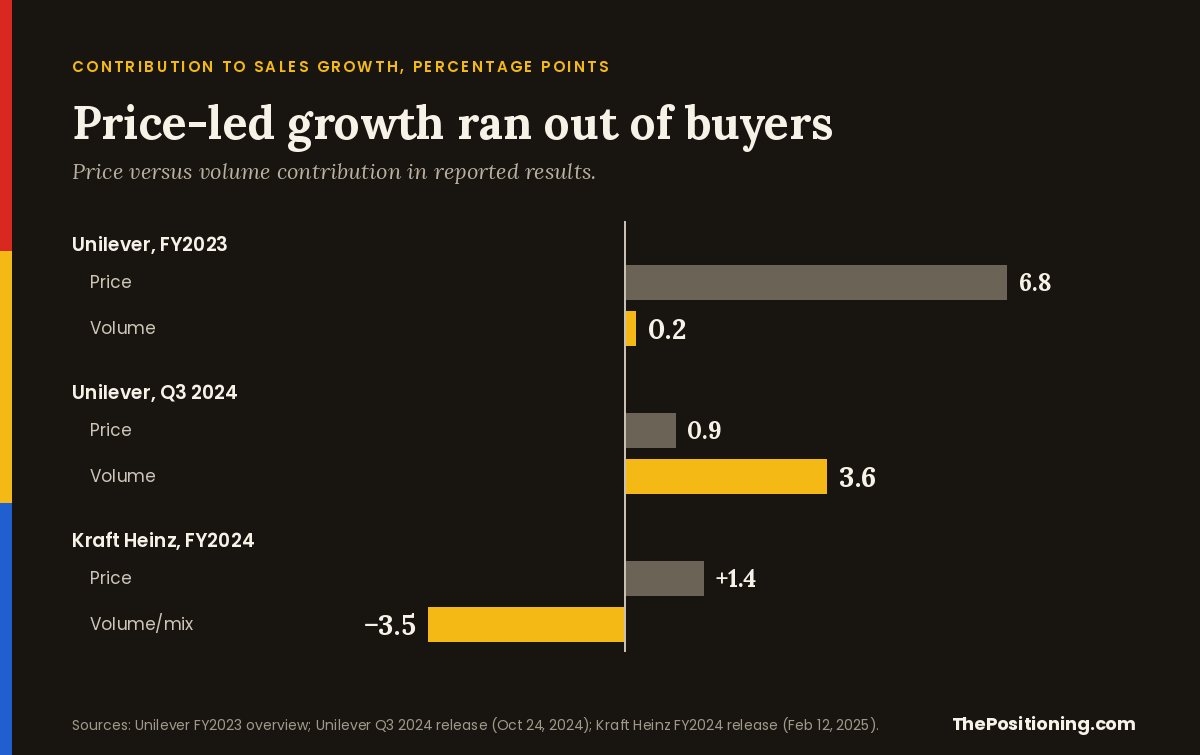
Unilever is the clean example of a company that saw it coming. Its FY2023 results showed 6.8% price growth and volume up just 0.2%: growth that was almost entirely price. By Q3 2024, price growth had moderated to 0.9% and volume growth rose to 3.6%. The mix flipped inside about a year.
Kraft Heinz is the comparison. Its FY2024 results showed organic net sales down 2.1%, made up of price up 1.4 points and volume/mix down 3.5 points. Price was still doing the work, and buyers were leaving faster than price could cover.
McDonald’s said the quiet part out loud. US comparable sales fell 0.7% in Q2 2024, and CEO Chris Kempczinski told analysts, as reported by Nation’s Restaurant News, that “these price increases disrupted long-running value programs and led consumers to reconsider their buying habits.” Executives said “value” 78 times on that call. When a company that built its brand on cheap and fast has to say “our value leadership gap has recently shrunk,” the reference price has won.
PepsiCo got there later and paid more for it. The volume of North American food fell by 1% in the quarter prior to the announcement of the cut, and General Mills had already said it would discount roughly two-thirds of its range. Neither company changed its brand. Both changed their price, because buyers had already changed what they were willing to pay.
Store brands turned value into a deliberate choice
Private label used to be viewed by marketers as the shopping option for recessions, as consumers trade down during hard times and trade up when times get better. This view is not supported by the data from the cooling years.
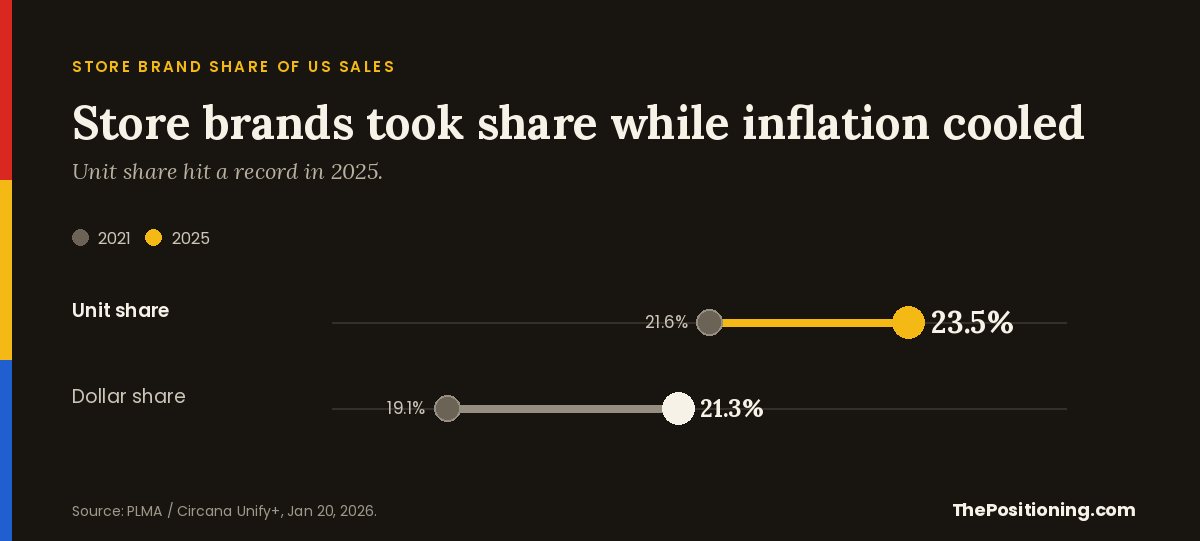
According to PLMA and Circana, store brand unit share rose from 21.6% in 2021 to a record 23.5% in 2025, and dollar share went from 19.1% to 21.3%. Store brand dollar sales hit a record $282.8 billion in 2025. Units rose 0.6% while national brand units fell 0.6%. That happened during the period when the inflation rate was coming down, not when it peaked.
Intent points in the same direction. According to McKinsey senior partner Emily Reasor in a September 2025 McKinsey podcast, “three-quarters of consumers tell us that they plan on trading down to some degree.” Note that this is a podcast remark and not a survey table, so treat it as directional only.
Buyers who don’t come back are the real cost of a long run of increases. Every quarter of such increases provides another reason for customers to try an alternative, and some of those customers will stick with the alternative for good. A customer who tried the store brand in 2022 out of necessity and found it acceptable has little reason to go back.
B2B buyers learned the same lesson at renewal
The people approving software renewals are the same people who watched their grocery bills go up while their companies cut costs for years.
SaaS vendors didn’t slow down. Vertice, which sells software-buying services and so has a stake in the story, reported SaaS prices up 11.4% year over year as of January 2025, against 2.7% average inflation across the G7. It also found that 58% of vendors raised prices in 2024, down from close to 75% in 2022. Fewer vendors are raising, but the ones that do are raising hard.
Price increases are brutal right now, and every business I talk to is looking for ways to increase efficiency. We are seeing a trend of businesses decreasing the amount of technology that they use and canceling subscriptions. Therefore, any SaaS tool that tries to increase prices for a customer’s renewal or increase the price of higher tiers will face pushback. Such a tool must be prepared to offer discounts and custom agreements in order to fight churn.
That last point matters more than it looks: if a vendor must discount down to last year’s prices to retain renewals then no increase was made; instead the vendor has introduced an additional negotiation step for buyers and confirmed to them that pushback on pricing works. In B2B the remembered price of a customer is what they paid on last year’s invoices, and the alternative price is the cheaper tool their peer just switched to. For the counterweight on seat pricing specifically, the data in seat-based pricing isn’t dying shows that model holding up even while buyers push back on the price attached to it.
Pass the Three-Price Test before you raise anything
Every price a buyer sees gets checked against three others. I call this the Three-Price Test, and a price that fails two of the three loses volume even when headline inflation is low.
The remembered price is what the consumer paid for a product before the run-up to the higher price. For a software buyer, it is the price of the first contract. That remembered price can’t be erased, but you can make the comparison unfair to the old price by showing what the buyer gets now that they didn’t get then. Unilever’s volume growth came with a value story, whereas Kraft Heinz’s price-only year did not.
The alternative price to purchase is the store brand, the $5 meal deal, or the lower tier option that is just one click away. Pack-price architecture is the honest tool for price sensitive buyers: a smaller entry pack or a lower tier lets them stay with you instead of leaving. McDonald’s built its $5 Meal Deal to win back customers that were being won over by the alternative price.
The justified price is what you can justify charging for your product based on the premium your value story is able to command at the shelf or in renewal meetings. This is where most price increases fail because the value story was never built in the first place. The work to create a value story is a brand job before it is a pricing job, which is the argument in pricing power is a brand problem.
My preferred model of defending the price of a software product is the squeeze model. Here, the entry level tier includes real features and is priced low enough that the customer can say yes to it. The middle tiers offer more value than the entry level tier but at an incremental price. The top tier, the enterprise or pro tier, includes even more value and is priced at a significantly higher level. This is designed to allow the customer to get started with the lowest tier and then be ‘worked’ up to higher levels. The middle tiers are ‘made better’ than the entry level tier but are not complete. This creates a ‘sunk cost’ moment for the customer where they are already paying for the mid-level tier so they might as well take the top tier with all of the features included.
The squeeze model passes all three prices. The entry tier price beats the alternative price. The upgrade path never raises the price on what the buyer already has, so the remembered price stays intact. And the top tier’s jump is justified by a visible step up in value. The honest limit of the squeeze model is that it only works when the upgrade path is fair. If the middle tier feels deliberately crippled then the buyer reads this as manipulation. This is especially true for price-sensitive buyers. (A later piece on good, better and best tiers goes deeper on how to build one.)
Tell buyers about increases early and explain why. PepsiCo announced its cut with a reason buyers could repeat. An increase also deserves the same treatment: date, amount and what pays for it, delivered before the invoice does the talking.
Price sensitivity is a learned skill, and it doesn’t make every increase wrong
None of this means prices can’t go up. It means they can’t go up on their own.
Procter & Gamble is the counterexample. In July 2025, P&G announced price increases on about a quarter of its US products, partly because of tariffs. CFO Andre Schulten noted that buyers were looking for value. He described how P&G had increased prices of Luvs products a few months before, but had also made product improvements, and Luvs gained market share. This is the Three-Price Test passed in public. The price went up, the product improved, and buyers accepted the justified price.
It’s also worth being honest about what buyers blame. Shrinkflation became the villain of the inflation years, but the GAO found that product downsizing accounted for less than one-tenth of a percentage point of the 34.5% rise in consumer prices from 2019 to 2024, and that fewer than 5% of items in each category it studied were downsized. The tactic people talk about most did very little of the damage. The ordinary price increase did nearly all of it.
The lesson is not “never raise prices” but rather that what buyers gained in the last few years was skill. Buyers know the price of old, they know where the cheaper alternative is and most importantly they know the difference between a price increase for a reason and a price increase without reason. A pricing team can still raise prices if they plan for this type of buyer. A pricing team that is still planning for the 2019 buyer will continue to lose volume quarter by quarter.
Sources: US Bureau of Labor Statistics, Consumer Price Index news releases, 13 October 2020 and 14 October 2026; Lebow & Peneva, “Inflation Perceptions During the Covid Pandemic and Recovery,” FEDS Notes, Federal Reserve Board, 19 January 2024; University of Michigan Surveys of Consumers, 24 October 2025; Kim & Yoon, “Grocery Inflation Is Low, but Why Do Consumers Feel It Is High?,” Choices, Q1 2025; Hernandez, “What is your ideal inflation rate?,” Monthly Labor Review, BLS, August 2024 (summarizing Afrouzi et al., NBER Working Paper 32379); Unilever, Full Year 2023 results overview and Q3 2024 trading statement, 24 October 2024; Kraft Heinz, Fourth Quarter and Full Year 2024 results, 12 February 2025; McDonald’s, Second Quarter 2024 results, 29 July 2024; Nation’s Restaurant News, 30 July 2024; NPR via OPB, 3 February 2026; PLMA/Circana, 20 January 2026; McKinsey on Consumer & Retail podcast, 8 September 2025; Vertice, “SaaS inflation,” 28 January 2025; Associated Press via WMBF, 30 July 2025; US Government Accountability Office, GAO-25-107451, 31 July 2025.
AI was used in research and formatting.

Written by
Ryan Frazier
He’s spent 18 years building and leading marketing teams, from Series A startups to multi-billion-dollar public companies — four of them scaled past the $50M, $100M and $250M ARR marks, and all four through to acquisition. He writes The Positioning, on why winning has less to do with being right than with being well-positioned at the convergence of time, place, and resource.
More about Ryan →

