Google, Microsoft and Amazon Now Set Your Ad Prices

Let’s say you beat your cost-per-acquisition target for your Google Ads campaign last quarter. You set $10 and paid $5, and somebody on your team got to put a green arrow on a slide. That’s a win, isn’t it?
As of August 17, Google treats that gap as a problem it has fixed.
Google changed how target-based bid strategies behave in campaigns that are limited by budget. Its own example is a Target CPA campaign set at $10 that has recently been converting at $5. Under the new behavior, that campaign will deliver closer to the $10 target. Google’s suggested remedy, if you liked paying $5, is to lower your target to $5.
That update got written up as a bidding tweak. Three days later Microsoft emailed advertisers and informed them that the Max CPC feature will be removed for new campaigns using automated bidding. Eleven days later the FTC and 22 states filed a lawsuit against Amazon alleging that what Amazon advertised as a second-price auction had been quietly charging most advertisers their full bid.
Each of these stories had their own news cycle. Read through them and you see one big shift: Control over price has moved from advertisers to platforms. The tools you used to set a ceiling have been redefined, removed or, if the Amazon allegations hold, quietly overridden.
Your target used to be a ceiling. Now it is your price.
According to Google’s help pages for Target CPA, the setting is an average. In some cases, conversions will cost more than the Target CPA, and in other cases they will cost less. However, Google’s help page says the system “will try to keep your cost per conversion equal to the target CPA you set.” So it aims for equal, not for below.
Because of budget constraints, many campaigns ran below target for months on end. The budget ran out before the algorithm had spent its way up to the number you had given it, so the cheapest conversions were the only ones you bought. Advertisers learned to read the target as a ceiling for their campaigns and the actual CPA as the price for a conversion. The efficiency is the difference between these two figures.
The August 17 change closes that gap, and that is by design. In Google’s words it “updated its bidding systems to deliver more consistent and predictable performance” based on your targets. Google notes that with the update, budget-limited campaigns will deliver more consistent performance against the target, even as budgets change. This change applies to Search, Shopping, Performance Max, Demand Gen and Travel campaigns. Hotel and Display campaigns already function this way. App and video reach and view campaigns will continue to use the previous behavior.
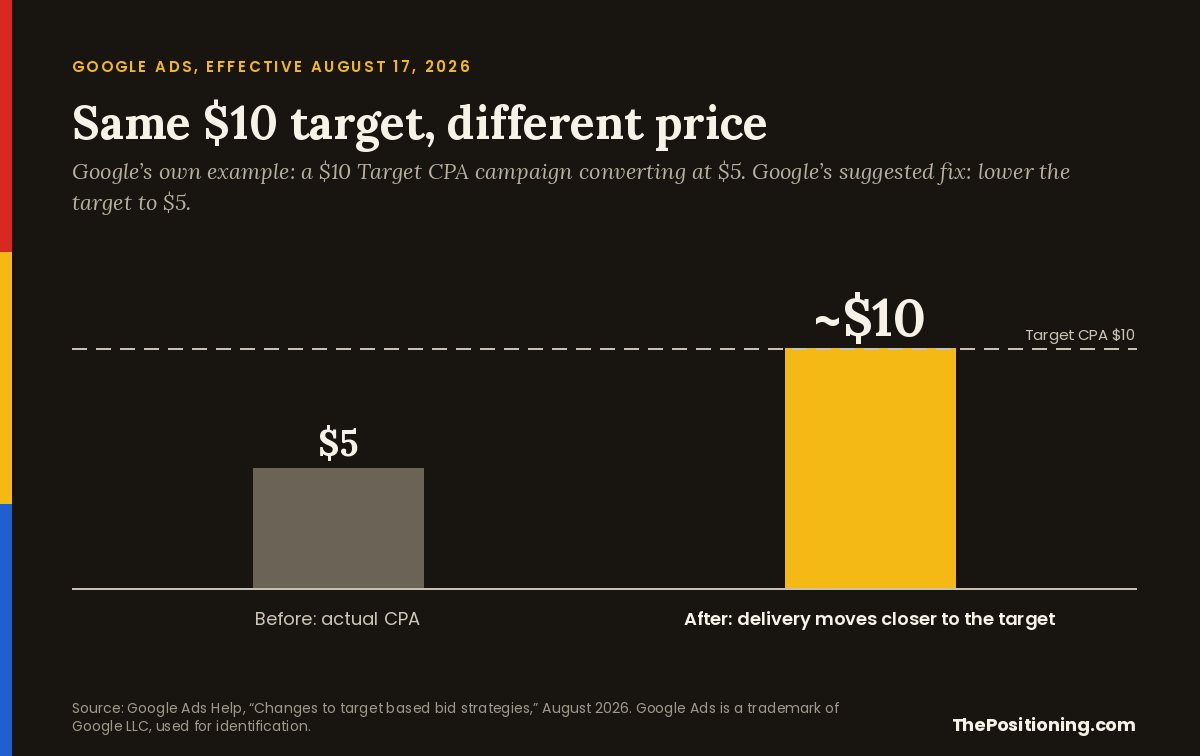
Note that Google does not change your targets or budgets. It only changes the meaning of the number you previously entered. A ‘cap’ target is now a ‘destination’ target. If you set your targets too high (too aspirational) then you have been bidding at a price that you never intended to pay. The August update starts to collect on this price.
The defensible reading is that Google is spending your budget more completely against a goal you set. That’s true. It’s also true that a campaign that is held at $10 when it could have been bought for $5 is effectively transferring the difference to the auction (which Google runs).
Microsoft removed the one setting that said no

Max CPC is the oldest and most crude form of control for search advertising. Whatever the algorithm thinks a click is worth, it can’t pay more than Max CPC. On automated strategies, Max CPC is used as a guardrail; the algorithm can bid to the amount of Max CPC but no more.
Microsoft Advertising told advertisers in an email on August 20 that “from 1 October 2026, Max CPC will no longer be available when creating new non-portfolio campaigns.” Search Engine Journal reported that the change applies to Target CPA, Target ROAS, Maximize Conversions, Maximize Conversion Value and Maximize Clicks, and that Microsoft’s reasoning was that the setting “can give the bidding system conflicting instructions.” Navah Hopkins, Microsoft’s Ads Liaison, put it more plainly on LinkedIn, as quoted by Search Engine Roundtable: “Max CPCs override stated goals and can lead to spend pacing irregularities.”
Overriding stated goals was the point. That’s what a ceiling is.
The detail is key. Existing campaigns keep their Max CPC for now. Portfolio bid strategies, Target Impression Share and Enhanced CPC retain the ability to set Max CPC. A second Microsoft email, reported by Search Engine Land on September 8, states that for API users, tool providers and Google Import, campaigns that are not using Max CPC can no longer be updated with Max CPC after January 12 and that removing Max CPC from a campaign after October 1 can’t be undone.
The ceiling remains but is now hidden behind a door marked ‘portfolio’ and each new standalone campaign you create from now on will start without it.
Microsoft deserves one point of credit that most of the coverage skipped. Hopkins in the same LinkedIn post stated that Microsoft “continues to allow campaigns to over achieve on TCPA/TROAS regardless of budget limited status.” This is opposite to Google’s change in August. For now, on Microsoft, achieving over the target is still allowed. That tells you Google’s behavior is a choice and not a law of automated bidding.
What happens to price inside an auction you can’t see
The Amazon case is a different case altogether, and must be read as such. These are allegations in a complaint, not findings.
The FTC and 22 states sued Amazon on August 31 in federal court in Seattle. The complaint quotes Amazon’s own website from 2022 to 2024: “Bidding on Amazon Ads is a second price auction.” In a second-price auction, the winner pays roughly what the runner-up bid. That design is the whole reason advertisers can bid their true value without overpaying.
The complaint alleges that starting in late 2018 and early 2019, Amazon began overriding that mechanism. It describes a hidden “proxy 2nd price” set by Amazon, and quotes internal language about “an invented auction participant representing how much Amazon thinks that particular ad slot is worth.” When the invented bidder’s price sits just under yours, a second-price auction becomes a first-price auction without anyone telling you.
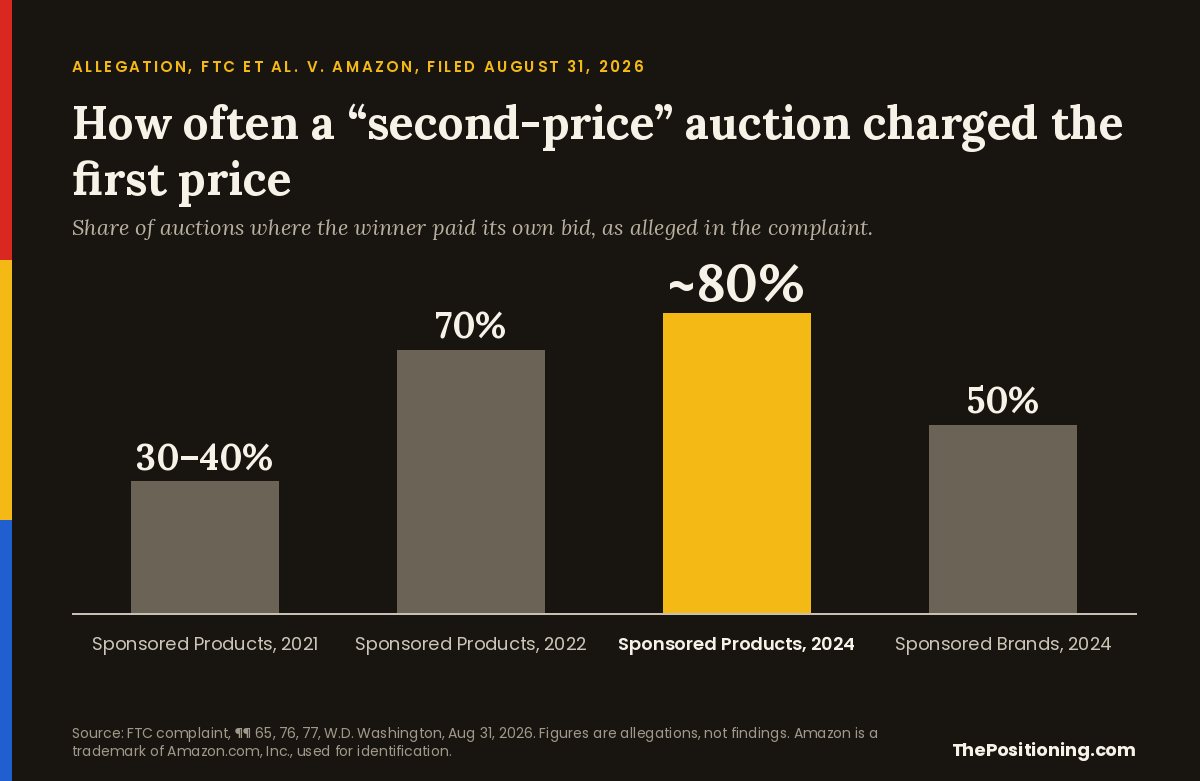
The complaint puts numbers on how often that happened. Sponsored Products advertisers paid their own bid in between 30% and 40% of auctions in 2021, 70% in 2022, and close to 80% in 2024. For Sponsored Brands in 2024, the figure was 50%.
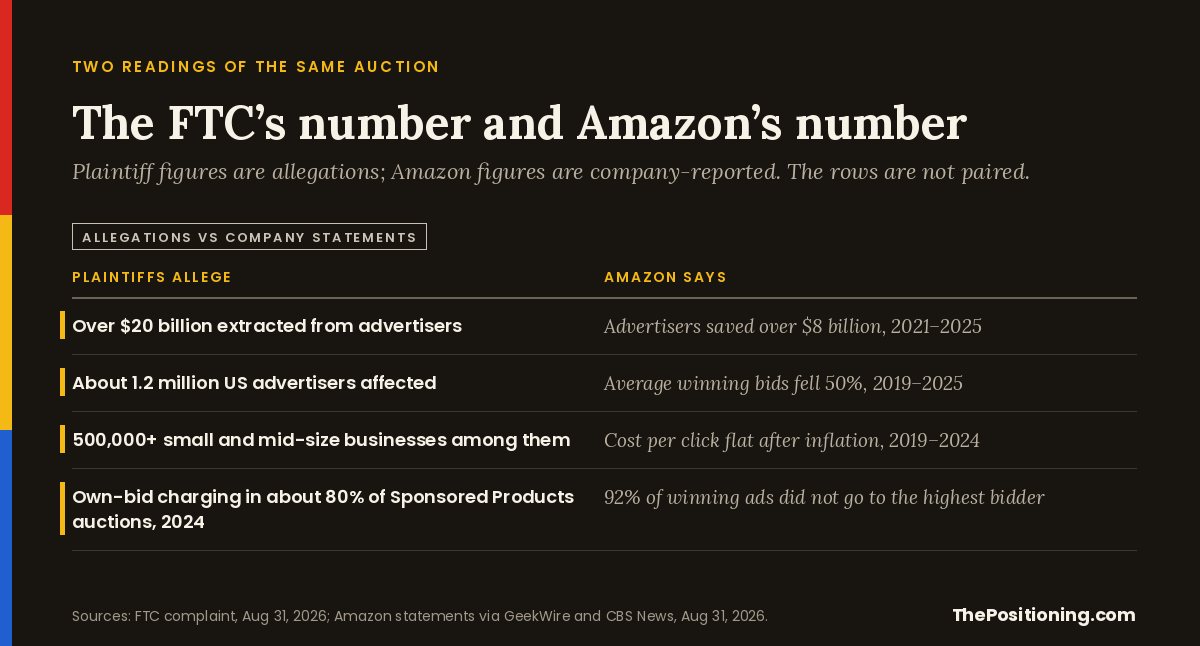
The complaint alleges Amazon “likely illegally extracted over 20 billion dollars” from roughly 1.2 million U.S. advertising customers, more than 500,000 of them small and medium-sized businesses. The FTC’s press release goes further and says “tens of billions.” FTC Chairman Andrew Ferguson said “Amazon has millions of advertising customers who were misled into paying significantly higher prices.”
Amazon’s response, as reported by GeekWire, is worth reading in full rather than in a headline. “The FTC’s claim fundamentally misunderstands how advertisers operate,” the company said. “Advertisers adjust bids based on real-world performance, not descriptions of auction mechanics.” It called reserve prices “common across the industry,” said 92% of winning ads in recent years did not go to the highest bidder, and said average cost per click for Sponsored Products search ads was flat from 2019 to 2024 after inflation. CBS News reported Amazon’s estimate that advertisers “saved over $8 billion from 2021 to 2025” because it ranks ads on relevance rather than bid alone.
Notice what Amazon’s best defense is. It is not that the auction worked as described in the help page. It is that advertisers do not bid off help pages, they bid off results. This may even be true. It is also an argument that the mechanism described on the help page does not matter as long as the outcome is acceptable. This is the argument of a platform when the platform controls the mechanism.
(This is a separate case to the Google ad-tech remedies case which was about publisher-side display ads in a different market to the bidding described here.)
One shift, three disguises
Put the three stories next to each other and the pattern is hard to miss.
Google redefined a ceiling as a target. Microsoft removed the ceiling from the default build. Amazon, allegedly, kept the label on the ceiling and moved the floor up underneath it until the two touched. The mechanisms differ but they point the same way: more and more, the number that decides your CPC is one the platform sets, or one it re-interprets after the advertiser has set it.
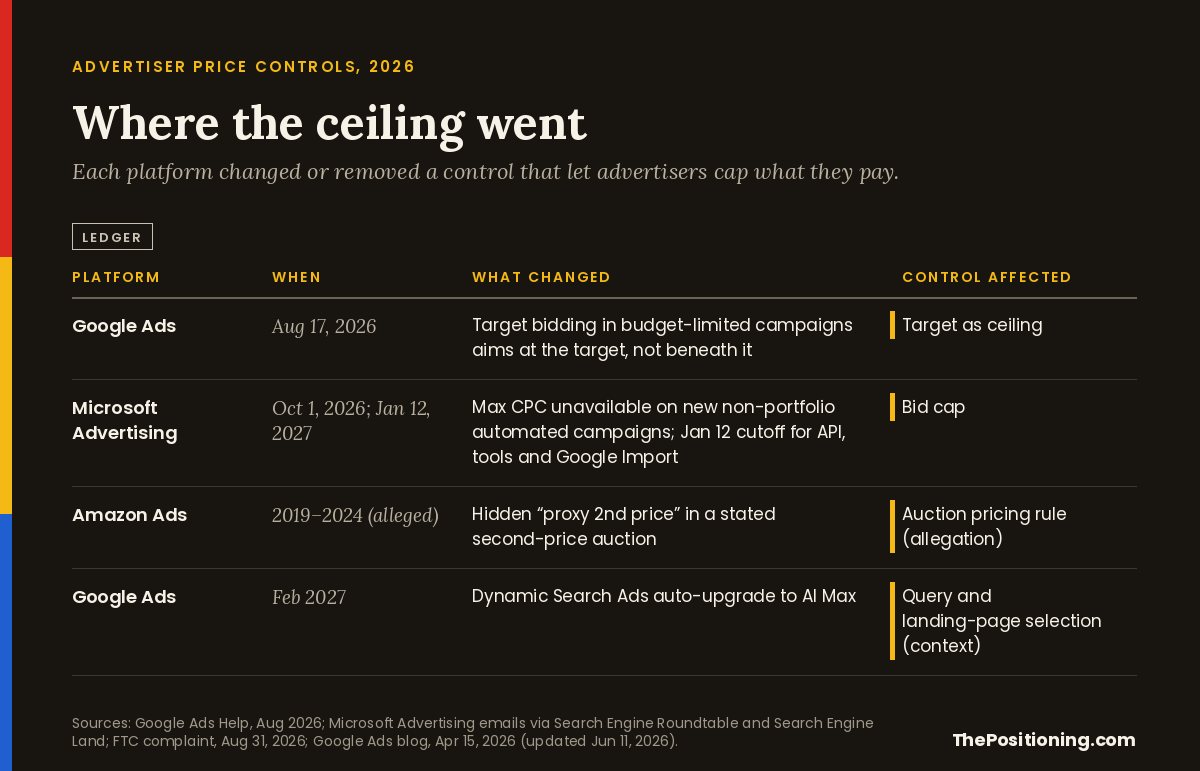
The fourth row is context, not evidence of the same thing. Google said in April that Dynamic Search Ads would upgrade to AI Max, then pushed the DSA auto-upgrade to February 2027. Google reports AI Max campaigns using the full feature set see an average 7% more conversions or conversion value at similar CPA or ROAS, based on its own internal data. That’s a claim about performance, not pricing. But it’s the same direction of travel: fewer decisions for the advertiser, more for the system.
This does not require bad faith on the part of the platform. An auction platform optimizing its own auction using some objective function that it defines in part, will tend to discover that more of the surplus belongs to the auction. That is what an incentive does. The algorithm does not need to be evil for the price to drift up to the top of what you said you would tolerate.
The five levers still in your hands
So, if the platform sets the clearing price for you, what is there left for you to set? I can only come up with five things. I’ll call them the five handles, the things still bolted to the machine on the advertiser’s side.
First, there is the target itself. On Google after August 17, the target for any budget-limited campaign is the price set for that campaign. So this number ends up being the single most consequential pricing decision in any paid program. Most teams set this number once a year from a planning spreadsheet.
The second is the conversion value you report. Target ROAS and Maximize Conversion Value both bid against the values you send back, so if those values are inflated or all the same, the algorithm will pay up for them. With the removal of Max CPC from the new Microsoft campaigns, the value that you pass to the system is one of the few variables that you can use to influence the system’s valuation of a click. The conversion value is a price lever, and typically resides with the owner of the tag, not with the owner of the budget.
The third handle is budget. On Google, budget no longer protects you from paying up to target, but it still caps total exposure. It is now one of only two hard limits left on a newly configured automated Microsoft campaign.
The fourth is the control cell: a portfolio strategy set with a Max CPC on Microsoft or a manually bid or capped campaign on other networks. It is the only way to know what the automated campaign would have cost you without automation. Without this control, any results are basically the platform rating itself.
The fifth lever is the contract itself. Agency contracts, platform insertion orders and retail media deals are negotiated in the fall of each year. These contracts are the only lever that operates entirely outside of the auction.
What to do before your 2027 plan locks
Re-baseline every target from paid reality, not from the plan. Pull the last 90 days of actual CPA and ROAS by campaign. For any target where actual results are significantly better than the target, the change on August 17 means you’re likely to pay closer to the target than you used to. In this case, Google’s advice is to lower the target to the recent level of performance. Then, put the re-baselined targets on the calendar for review quarterly, because what was right in January is wrong by April. How to read a benchmark applies here as well: the number in the plan was a guess, the number in the account is a measurement.
Review what you report as value for conversion. Review value rules, offline conversion imports and lead-scoring weights used for tROAS. For each of these, ask yourself: if this value were 20% higher than it actually is, would anyone ever notice? If the answer is “nobody, ever”, then you have found an unpriced lever. This is where paid search and marketing accountability meet. The value you report is the price signal that you are sending to the auction and, in most cases, finance has never looked at this value.
Keep a control cell on purpose. On Microsoft, keep a portfolio strategy with a Max CPC running on a slice of spend before January 12, when the tool and API path closes for existing campaigns that don’t already use it. Remember that removing Max CPC after October 1 is irreversible, so don’t strip it out of legacy campaigns casually. On Google, hold a small campaign on a capped or manual strategy, or run a structured experiment, so you have a reference price that the platform didn’t set. The cell doesn’t have to win. It has to exist, so that when automation tells you a click costs $6.40, you can check.
This fall, write auction terms into your contracts for retail media and marketplace ads. Ask for the auction type in writing, reserve or floor price, and share of auctions you paid your own bid in, for each quarter. The Amazon complaint, regardless of how it shakes out, is useful because it establishes that this can be calculated as a metric. For agencies, require that all changes to targets be logged with reasons for the changes, and that you have audit rights over conversion value configurations.
Finally, change who owns the number. If the target is now the price, the target is a pricing decision, and pricing decisions in most companies require more than one signature. A paid search manager adjusting tCPA by 30% is repricing your customer acquisition cost, and that deserves the same scrutiny as a change in the price of the product itself.
What this does not mean
To clarify, automated bidding is not worse than manual bidding for most advertisers. In fact, Smart Bidding and its variations outperform human bidding for most advertisers, across most volumes of traffic, because it can consider many more signals than a human, and make bid changes much more quickly than a human. The 7% figure of AI Max for Google is also company-reported and self-graded, but the general direction of Smart Bidding over the last 10 years of tests holds true and I am not going to argue with that.
It doesn’t mean prices are spiking. WordStream by LocaliQ’s 2026 Google Ads benchmarks, covering 13,474 U.S. campaigns from April 2025 to March 2026, put the typical cost per click at $5.42 and described year-over-year results as “fairly stable.” It also reported that cost per lead in Google and Microsoft Ads fell for the first time in five years. If the platforms were simply extracting more, you would expect that number to point the other way. Its sample ends before the August change, so watch the next edition.
This doesn’t mean Amazon has committed any of the actions alleged in the FTC and states complaint. Amazon disputes it with numbers of its own, and a court hasn’t ruled. Use the case as a reason to look into how your auctions work, not as a proven fact as to how Amazon’s auctions worked.
It does not mean that the platforms are wrong about conflicting instructions. A tight Max CPC on a Target ROAS campaign conflicts with the algorithm and some advertisers have even choked their own campaigns with such settings.
The problem is narrower and more durable than any of these. The party that runs the auction now also sets, or reinterprets, the price you pay in it. And we are able to see less of how the auction works than we did two years ago. This is an incentive problem and an information problem, not an algorithmic problem. The algorithm can be great but still charge you the upper end of your range, because that’s the number you gave it.
Which is the useful part. You still choose that number.
Sources: Google Ads Help, “Changes to target based bid strategies,” effective August 17, 2026 ($10 Target CPA example; covered campaign types; recommendation to lower the target to recent performance). Google Ads Help, “About Target CPA bidding,” accessed October 2026 (“will try to keep your cost per conversion equal to the target CPA you set”). Microsoft Advertising advertiser email, August 20, 2026, “Updates to Max CPC for new campaigns,” and second email, September 2026, as reported by Search Engine Roundtable (Barry Schwartz, August 21, 2026, updated September 8), Search Engine Journal (Brooke Osmundson, August 20, 2026) and Search Engine Land (Anu Adegbola, September 8, 2026); Navah Hopkins, Microsoft Ads Liaison, LinkedIn, August 20, 2026, as quoted by Search Engine Roundtable and PPC Land. FTC press release, “FTC, States Sue Amazon Over Secret Ad Surcharge Scheme,” August 31, 2026, including Chairman Andrew N. Ferguson’s statement; FTC et al. v. Amazon complaint, U.S. District Court for the Western District of Washington, August 31, 2026 (paragraphs 1, 3, 4, 10, 48, 65, 76, 77, 127). Amazon statements via GeekWire and CBS News, August 31, 2026. Google Ads blog, Brandon Ervin, “Google’s Dynamic Search Ads are upgrading to AI Max,” April 15, 2026, updated June 11, 2026. WordStream by LocaliQ, Google Ads Benchmarks 2026, updated May 19, 2026.
AI was used in research and formatting.

Written by
Ryan Frazier
He’s spent 18 years building and leading marketing teams, from Series A startups to multi-billion-dollar public companies — four of them scaled past the $50M, $100M and $250M ARR marks, and all four through to acquisition. He writes The Positioning, on why winning has less to do with being right than with being well-positioned at the convergence of time, place, and resource.
More about Ryan →