AI ARR Is the New Adjusted EBITDA. OpenAI’s $20B Gap Proves It.

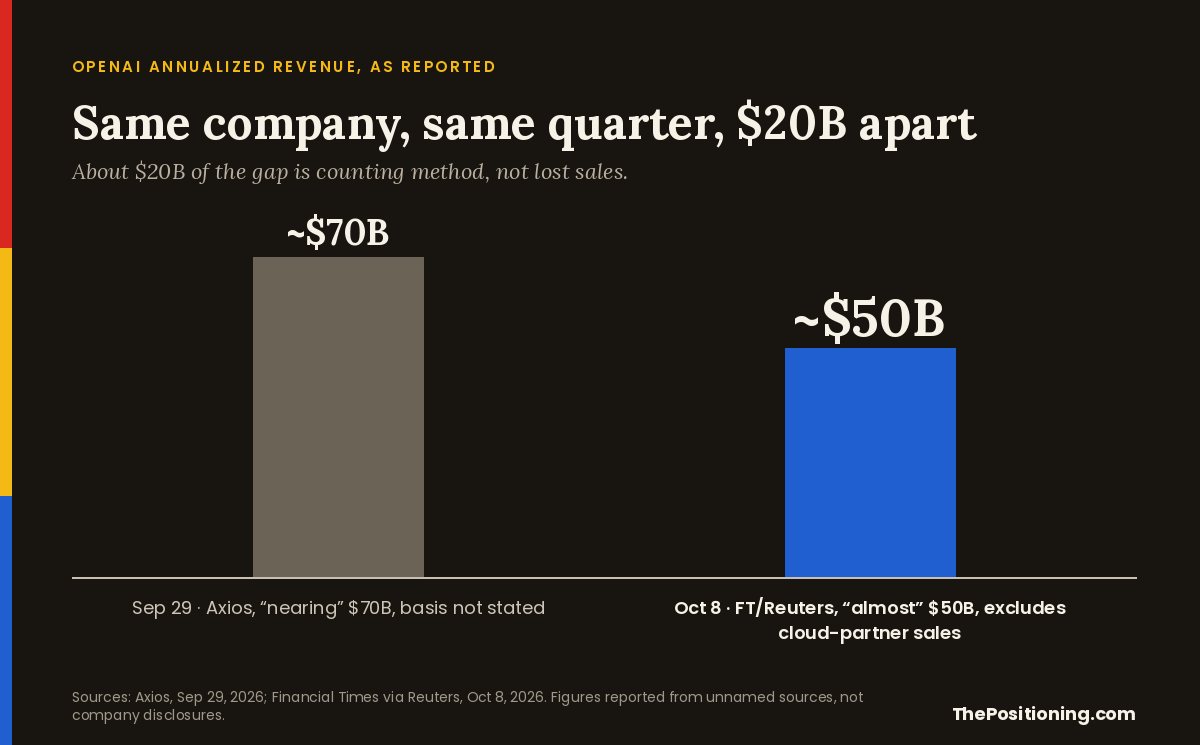
On September 29, Axios reported that OpenAI’s annual recurring revenue (ARR) was nearing $70 billion. On October 8, the Financial Times reported that the company had told investors its September annualized revenue was almost $50 billion. No customer contracts were canceled, and no products failed in the interim. Approximately $20 billion of revenue disappeared due to a change in the way revenue was measured.
This was not treated as a footnote by the markets. Oracle dropped 5.48% for the day, CoreWeave was down 7.77%, Broadcom down 4.35% and Nvidia down 2.94%.
This isn’t about OpenAI; this is about how everyone in software has gotten into the habit of reporting an AI revenue line, and how there isn’t a single common definition for any of them. There’s run rate, RPO (Remaining Performance Obligations), “AI ARR”, “AI-First ARR”, “Agentforce ARR”. They all use what sounds like accounting. They’re mostly marketing with a decimal point.
AI ARR is the new adjusted EBITDA, a number that companies can freely build however they like and then present to investors next to audited figures. Adjusted EBITDA is usually accompanied by a reconciliation, but AI ARR mostly is not.
Nine days, one company, $20 billion apart
Here is what actually happened, as best the reporting allows.
Axios on September 29 reported, citing sources familiar with the financials, that OpenAI’s annual recurring revenue was “nearing $70 billion” and up over 70% from the start of the third quarter. Some outlets went with a “widely cited” $68 billion figure. In the headline Axios wrote “annual recurring revenue” and in the body of the article used the term “annualized revenue run rate” for the same number without any distinction.
FT reported September revenue figures on October 8 to be around $50 billion. This figure was later confirmed by Reuters via a person familiar with the matter. The person said that the discrepancy “mainly arose from an attempt to produce a direct comparison with figures from rival Anthropic.” Reuters added that OpenAI does not include revenue from sales through cloud partners such as AWS and Google Cloud in its figures, whereas Anthropic does.
According to the reporting, this explains the gap. In accountant’s terms this is a gross-versus-net issue. If a customer buys OpenAI models via a cloud marketplace one method books the full sale and records the partner’s cut as a cost, and the other books only the portion OpenAI keeps. From the analysis by Reuters, Anthropic pays out about 16% of every dollar earned via cloud partners to the partners themselves. Neither the FT nor Reuters described the gap with the words “gross” and “net”; that is the reporters’ mechanism translated into accountant’s language, and I’d flag it as an inference rather than a disclosed methodology.
The next day Bloomberg reported that OpenAI expects to have reached or exceeded $70 billion in annualized revenue by the end of the year. Thus, the company may well hit the number that the market already believed it to have, but it will do so three months later on a different basis.
Why a definition moved four stocks
As OpenAI is a private company, it does not have to file 10-Qs. So why did publicly traded companies lose billions in value over the private company’s methodology for calculating revenue?
Because OpenAI’s revenue is their collateral. Oracle builds data centers for OpenAI, CoreWeave rents it compute, and Broadcom designs custom chips for it. Each of these companies has made multi-year commitments to support OpenAI based on the assumption that OpenAI’s revenue will grow into its spending. If the top line of the most important customer in the sector turns out to be a definition rather than a fact, every downstream forecast is re-underwritten at once.
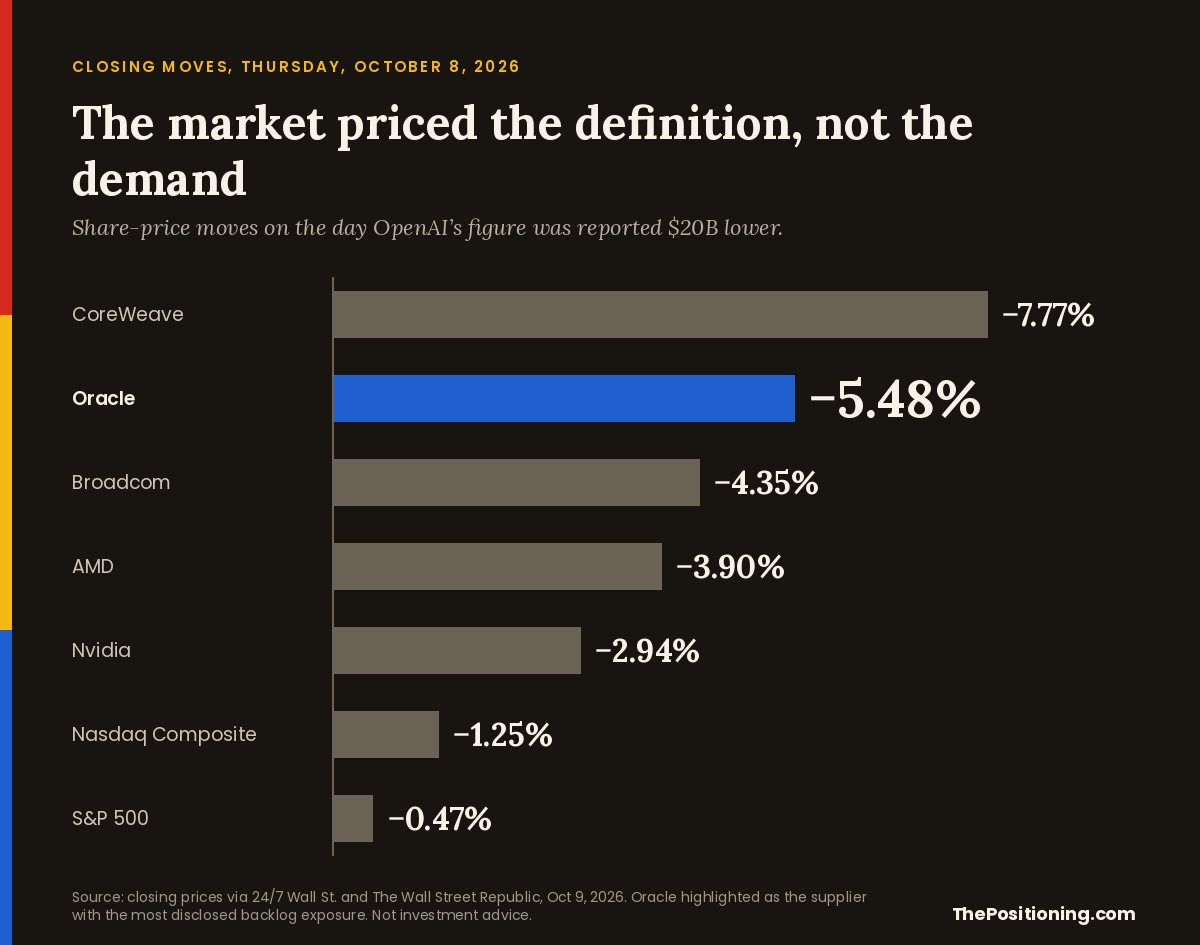
Whether or not this selloff was justified is not for me to say. Plenty of analysts argued the next day that the market had mistaken accounting for demand, and they may be right. The point for an operator is narrower: a number quoted as fact for nine days turned out to depend entirely on a choice nobody had disclosed. That is the risk your own board deck carries.
Run-rate is a strong month with a multiplier

First, the oldest metric of the three: run-rate. This is typically calculated as one month’s revenue multiplied by 12. As Reuters reported on October 8, analysts consider run-rate a “sometimes misleading sales metric”.
Run-rate is a useful measure for fast growing companies where last year’s revenue is irrelevant. Reuters reports that OpenAI started 2026 with an annualized revenue of $20bn, up from $6bn in 2024. This business is growing so fast that trailing revenue is irrelevant, and the latest month’s revenue is the best signal available.
Note that run-rate inherits all of the decisions made in the underlying month. That includes whether it is gross or net of partner sales, whether a large prepaid contract recognized in that month is smoothed or spiked, and whether consumer subscriptions billed annually are counted at their monthly equivalent. Multiply any one of those by 12 and a small judgment becomes a large number.
There’s a time problem here, too. According to Bloomberg, the annualized revenue of Anthropic reached $65 billion at the end of July. OpenAI’s revenue of $50 billion is as of September. So, two methods for two different months and the headline compares them, leading readers to believe there is only one ranking.
RPO is a promise, and sometimes one customer’s promise
Remaining performance obligations (RPO) sound more solid than run-rate, because they are. RPO is a GAAP disclosure of revenue contracted but not yet recognized, which is audited. It is also the number most often misread in AI infrastructure.
Oracle released its Q1 FY27 results on Sept. 10; RPO was reported at $664 billion — an increase of $209 billion compared to last year. Cloud Infrastructure Revenue grew by 121 percent from last year, to $7.4B. During the earnings call, the Oracle CFO stated that they expect approximately half of their RPO to be converted into revenue within the next three years.
RPO doesn’t tell you two things. First, who the commitments are from: Oracle does not disclose the details of the commitments made by individual companies, including OpenAI. Asked about concentration, Oracle’s CEO described demand as “really broad based.” The roughly $300 billion, 5-year compute contract that Oracle has with OpenAI starting in 2027 was reported by the Wall Street Journal in 2025. If all of it sits in RPO, that number is just under half of Oracle’s total, and so it has been characterized as such by The Motley Fool and others. That is press arithmetic, not a company disclosure.
Second, RPO doesn’t tell you what it costs to deliver. Oracle’s own release does.
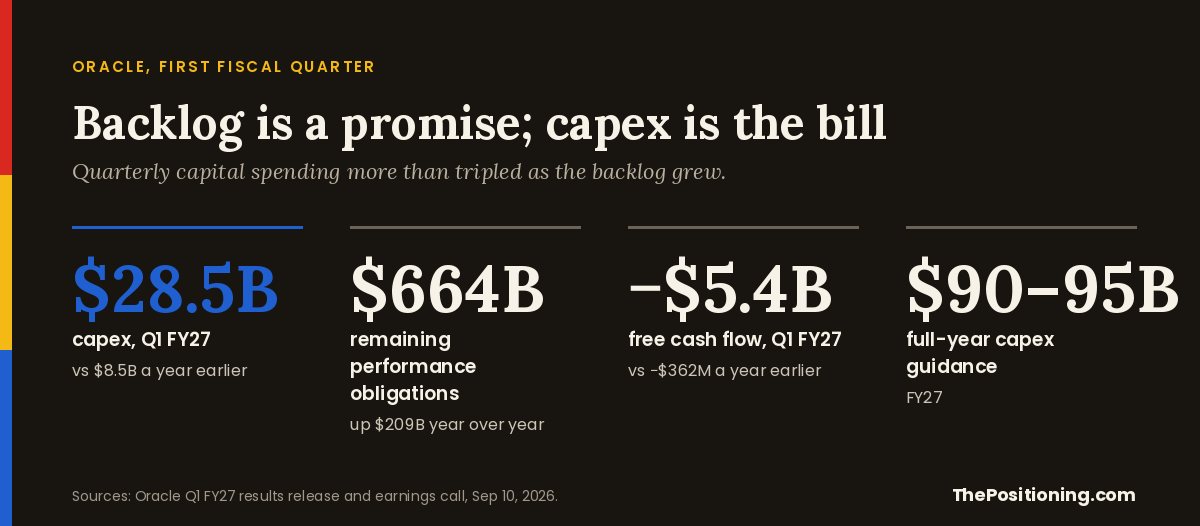
Capex for Oracle went from $8.5 billion to $28.5 billion in a year. Free cash flow for the company went from roughly break-even to negative $5.4 billion. That is not a criticism of Oracle’s strategy, which may be exactly right. That backlog is money the customer has promised to spend and Oracle has to spend first to realize that revenue. And, in this case, a meaningful portion of that backlog is from one customer and that customer’s revenue figure recently moved by $20 billion on a definition, so the backlog and the definition are the same risk under different names.
AI ARR is whatever the company says it is this quarter
While run-rate and RPO are relatively well understood, the newest metric for software companies – AI ARR – has no conventional meaning. Every major software company now publishes something called AI ARR, and each one has drawn the boundary differently.
Salesforce is perhaps the cleanest example of a boundary moving. In its Q1 FY27 release on May 27, Salesforce reported that Agentforce ARR was $1.2B up 205% year over year. In its Q2 FY27 release on August 26, Salesforce reported that Agentforce ARR was in excess of $1.5B up over 240% year over year. Agentforce ARR now includes Salesforce’s AI offerings Slackbot and Headless 360, beginning in Q2 FY27. Salesforce also reserves the right to update this metric to include any new products, feature offerings or acquired technologies that fit the definition of Agentforce ARR .
Part of the jump from $1.2 billion to $1.5 billion is the inclusion of new products. The release does not state how much this is nor does it state whether the 240% is comparable to prior quarters. To be fair, Salesforce told you this in the release. But a reader comparing headlines from quarter to quarter would not know that the ruler had been changed.
Adobe’s Q3 FY26 release on September 10 states that “Adobe AI-first ARR grew more than 150% year over year” but does not give a dollar figure. During the earnings call Adobe’s CEO put it at “now exceeding $650 million.” This would represent over 2% of Adobe’s Total ARR of $27.5 billion. No definition of “AI-first” products was given on the call.
Microsoft is the largest number with the least scaffolding. On its April 29 earnings call Microsoft CEO Satya Nadella said that the company’s AI business had surpassed $37 billion ARR, up 123%. Later on in the call CFO Amy Hood referred to the same figure as an annual revenue run rate, but she, too, failed to explain what was included in that figure.
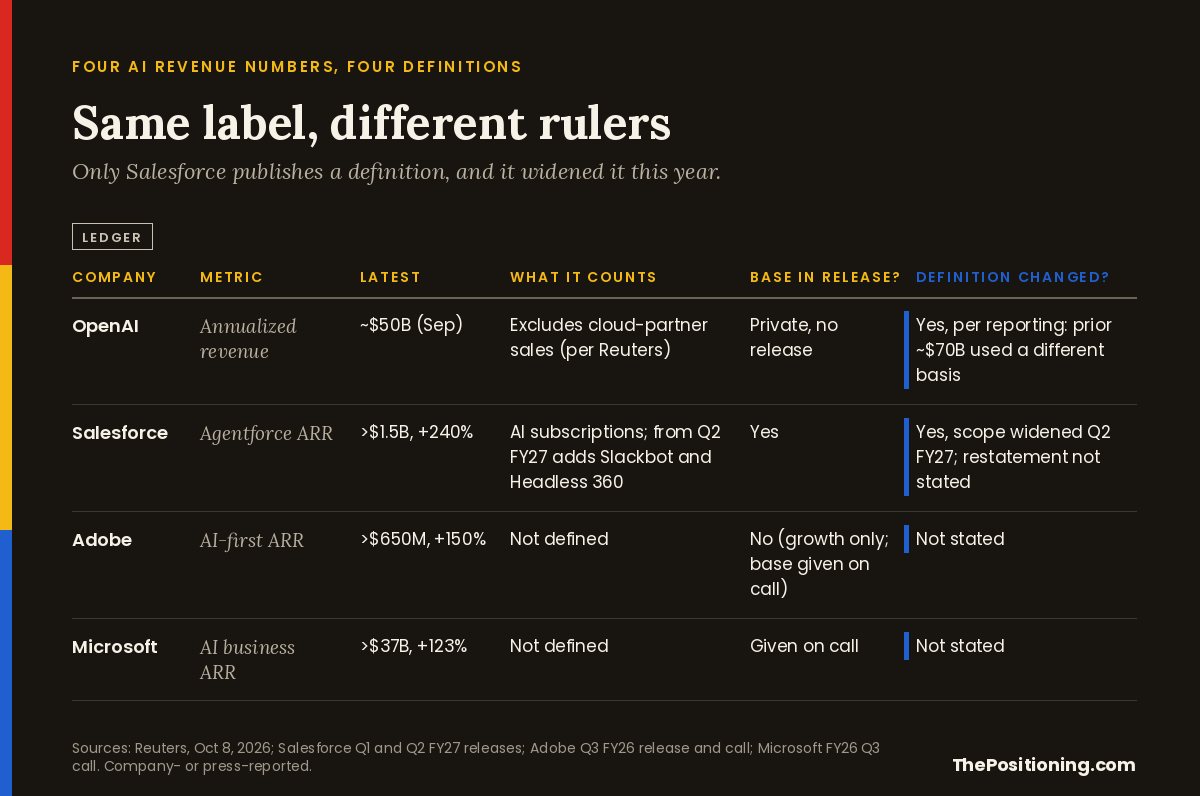
None of these companies did anything wrong. That is uncomfortable. All numbers in the ledger are allowed. At least one is footnoted. However, the market reads them as one category and they are not.
The reconciliation that should already exist
There is already a precedent for this type of guidance from the SEC. In January 2020 the SEC issued interpretive guidance in the form of Release 33-10751, on key performance indicators in Management’s Discussion and Analysis (MD&A). As described by KPMG in its summary of the release, the SEC expects KPIs to be clearly defined, with how it is calculated, why it is useful, and how management uses it disclosed. When the calculation of a KPI changes, companies should consider disclosing the difference from prior years’ calculations, the reasons for the changes, the effects of the changes, and whether prior periods’ KPIs should be recast.
Note that the guidance above covers what goes in the filed MD&A. It doesn’t police a CEO’s prepared remarks, a slide at an investor day, or a figure shared with private investors that ends up in Axios, which is where most AI revenue figures live.
So I’d borrow that logic and apply it ourselves. I call it the four-line reconciliation. Any AI revenue number, yours or anyone else’s, should be able to answer four questions, one line each, before it goes on a slide.
Line one: gross or net? Does it include full value of sales through partners, marketplaces and resellers or just what you get to keep? This is the OpenAI line. It is worth $20 billion at the top of the market, and probably a meaningful percentage of your number if you sell through AWS Marketplace, reseller channels or through OEMs.
Line 2: Committed or Consumed? Is this money that the customer committed to spend or money that they actually used? RPO is committed revenue. Consumption revenue is consumed revenue. A prepaid AI credit pack is committed until it is burned, and many credit packs are never burned. Oracle’s CFO noted that most new contracts came “via prepay or bring your own hardware.” This line exists to surface that detail.
Line three: bought or bundled? Was the AI paid for separately or is the AI number an allocation of a seat or platform price that would have been paid anyway? If your AI ARR includes a share of a bundled tier, then please state so and then state how that share was set. As I wrote in seat-based pricing isn’t dying, most vendors are stacking up the pricing of AI on top of the pricing of seats, as opposed to replacing the seat-based pricing with AI-based pricing. This stacking up of pricing will necessarily require an allocation of the total price between the various components, and this allocation is where the AI numbers will quietly inflate.
Line four: redrawn or restated? Has the definition changed since you last reported it, and if so, have you recast the history? Salesforce redrew its definition. Did it restate? The press release does not state. If there is no restated prior period then a growth rate across a redefinition is two numbers measured with different rulers.
Four lines. If a number does not pass all four lines it is not necessarily wrong, but it cannot be compared and should not be compared with other numbers.
What to do before Q3 earnings and 2027 planning
Earnings season for the July–September quarter is starting this month and many of you are in the process of building your 2027 plan. In both of these moments the revenue numbers for AI get written down and then quoted for a year. A few concrete moves.
Write your own definition before someone asks. Put the four lines on one page: what is in, what is out, gross or net, committed or consumed, how bundled revenue is allocated, and the date the definition took effect. Have finance sign it. Treat this as you would treat a non-GAAP reconciliation as it is functionally equivalent.
Make sure to show the reconciliation on the board slide, not in the appendix. For example, if you report $40 million of AI ARR, the slide should say “$40M (net of marketplace fees; consumed and committed; excludes bundled tiers).” A board member who has watched Oracle’s stock this week will ask anyway. Answer first.
If you change the definition of a metric then you must restate history on that same slide. Show the old basis and the new basis for at least four quarters. Measuring growth rate on a redefinition without restating the base is the fastest way to turn an honest metric into a misleading one.
Note: Keep AI Revenue and AI-influenced Revenue on separate lines. If marketing wants an “AI-influenced pipeline” number then fine but make sure you label it as influence in the same way that good attribution work separates out touch from cause.
Run the four lines on your vendors and partners. When a vendor tells you its AI product is used by thousands of customers and growing triple digits, ask: gross or net, committed or consumed, bought or bundled, redrawn or restated. When a partner pitches a co-sell motion based on its AI ARR, ask the same. You’re not auditing them. You’re finding out whether the number you’re about to plan around means what you think it means.
Check the cost line next to the revenue line. A rising AI revenue number with an undisclosed delivery cost is only half a fact. The SaaS gross margin reset explains why: AI revenue carries inference costs that the seat revenue beside it never did. Oracle’s capex line is the infrastructure-scale version of the same point.
Benchmarks have the same problem at the survey level: the median is built from respondents who each define the metric in their own way. See how to read a SaaS benchmark to complement this post if you are also reading third-party benchmark reports to set 2027 targets.
What this does not mean
It doesn’t mean these numbers are fraudulent. Nothing in the reporting suggests OpenAI, Salesforce, Adobe or Microsoft has misstated anything. The scope change for Salesforce was reported in writing. The base number for Adobe was reported during the call. The lower number for OpenAI was reported using the more conservative method, not the other way around.
This does not mean that run-rate is useless. For a business that has more than doubled in a year, a single month of strong performance annualized can be the best estimate available. This would be better than a trailing figure that is already out of date.
To be clear, this does not mean that the AI revenue is smaller than it appears to be. OpenAI may achieve its target of $70 billion by the end of this year, as reported by Bloomberg. Oracle’s backlog may be converted into revenue as planned. By the companies’ own figures, these AI revenue lines are growing at rates between 123% and 240% per annum, much faster than the rest of the business.
This is not a view on any stock and I am not giving advice on where any share price should go. I am merely explaining how a metric is used.
What it does mean is narrower and more useful. The labels have outrun the definitions. “ARR” used to mean roughly the same thing at every software company. Right now, ARR with “AI” attached to the beginning of the term means whatever each software company decides it means for the quarter, with or without a footnote explaining the term. The same thing happened with Adjusted EBITDA years ago. Years of creative definitions for the term were used by companies before investors started demanding the reconciliation as the price of being believed.
AI revenue is at the beginning of that cycle. You can either wait for the market to ask for reconciliation from you or put it on your slide first.
Sources: Axios, Madison Mills, “Scoop: OpenAI’s annual recurring revenue nears $70B,” 29 Sep 2026; Yahoo Finance, Daniel Howley, 29 Sep 2026 (Axios figure); Quartz, “OpenAI corrects annualized revenue figure to $50 billion,” 8 Oct 2026 ($68B “widely cited” figure); Financial Times, 8 Oct 2026, as reported by Investing.com, 8 Oct 2026; Reuters, Jaspreet Singh and Krystal Hu, “OpenAI’s September annualized revenue nears $50 billion, less than previously indicated, source says,” 8 Oct 2026 (cloud-partner treatment; Anthropic’s ~16% partner share; OpenAI’s $20B start to 2026 vs $6B in 2024; run-rate as “a sometimes misleading sales metric”); Bloomberg, Rebecca Torrence and Shirin Ghaffary, “OpenAI Expects $70 Billion in Annualized Revenue by End of 2026,” 8–9 Oct 2026, via Yahoo Finance Canada (also Anthropic $65B annualized at end of July); 24/7 Wall St., 9 Oct 2026, and The Wall Street Republic, 8 Oct 2026 (closing moves); Oracle Q1 FY27 results release, 10 Sep 2026 (RPO $664B, +$209B; OCI revenue $7.4B, +121%; capex $28.5B vs $8.5B; free cash flow −$5.4B vs −$362M); Oracle Q1 FY27 earnings call, 10 Sep 2026, via The Motley Fool transcript (half of RPO to convert within 36 months; “prepay or bring your own hardware”; “really broad based”; $90B–$95B FY27 capex); The Wall Street Journal, 10 Sep 2025, via DatacenterDynamics, 11 Sep 2025 (~$300B, five-year OpenAI–Oracle contract from 2027); The Motley Fool, Keith Noonan, 17 Sep 2026 (OpenAI share of Oracle RPO characterization); Salesforce Q1 FY27 results release, 27 May 2026 (Agentforce ARR $1.2B, +205%); Salesforce Q2 FY27 results release, 26 Aug 2026 (Agentforce ARR >$1.5B, +240%; scope change; metric definition); Adobe Q3 FY26 results release, 10 Sep 2026 (AI-first ARR >150%; total ARR $27.5B) and earnings call, 10 Sep 2026, via The Motley Fool transcript (>$650M); Microsoft FY26 Q3 earnings call, 29 Apr 2026 ($37B AI business ARR, +123%); SEC Release 33-10751, Commission Guidance on Management’s Discussion and Analysis of Financial Condition and Results of Operations, January 2020, as summarized by KPMG, February 2020.
AI was used in research and formatting.

Written by
Ryan Frazier
He’s spent 18 years building and leading marketing teams, from Series A startups to multi-billion-dollar public companies — four of them scaled past the $50M, $100M and $250M ARR marks, and all four through to acquisition. He writes The Positioning, on why winning has less to do with being right than with being well-positioned at the convergence of time, place, and resource.
More about Ryan →