Answer Engine Optimization (AEO): The SEO Successor Every Marketer Needs to Understand Now
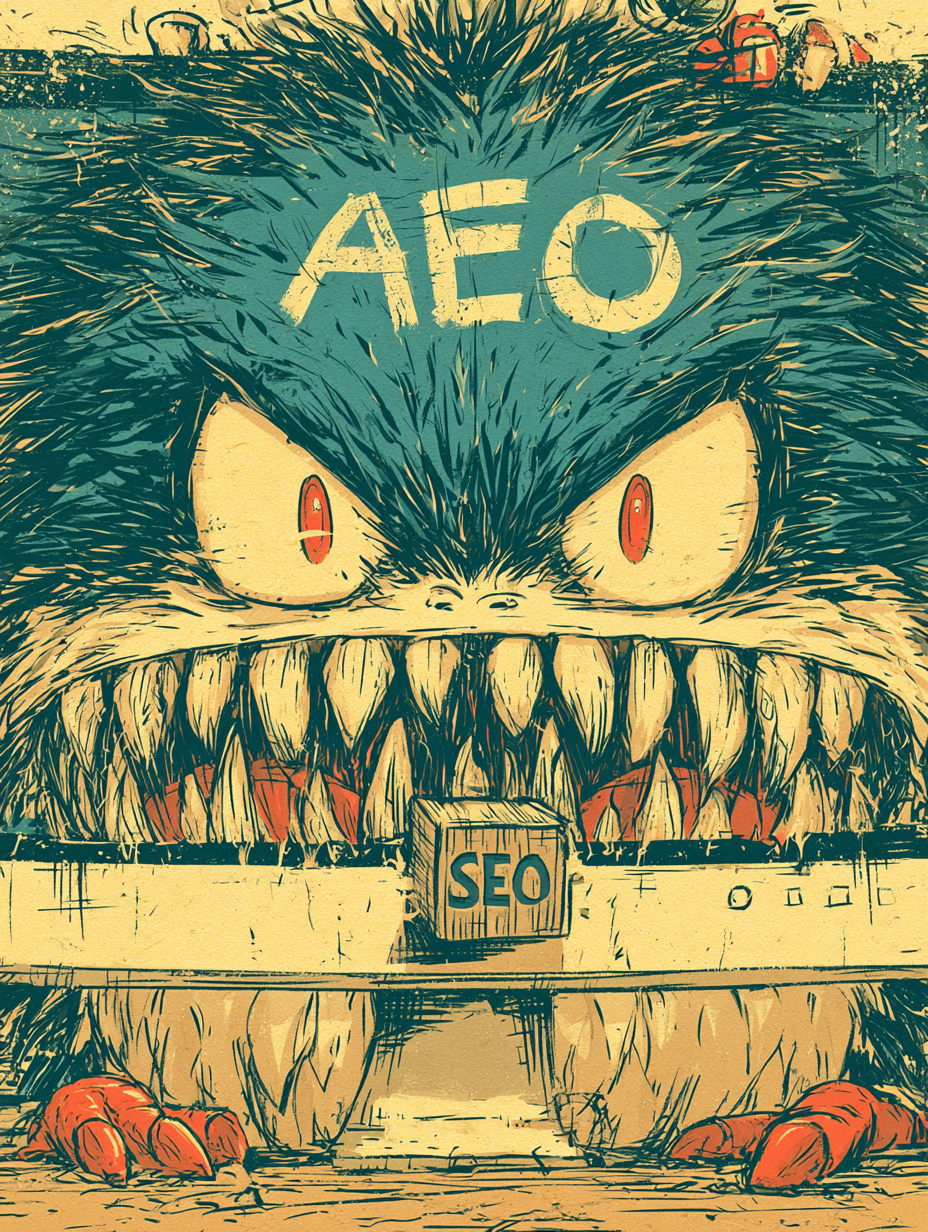
Your content is ranking. Your traffic is falling. Both things are true at the same time — and if you haven’t figured out why yet, you’re about to.
Ahrefs analyzed 300,000 keywords in December 2025 and found that a position-one Google ranking loses 58% of its historical click-through rate when an AI Overview is present. For every hundred clicks a top-ranked page used to earn, Google now keeps 58 of them — delivering the answer directly, sending the user nowhere. Traditional SEO got you the ranking. The ranking no longer guarantees the traffic. The game has changed underneath the scoreboard.
This is the structural shift that Answer Engine Optimization exists to address. AEO isn’t a replacement for SEO — both still matter, and good AEO work tends to reinforce traditional rankings anyway. But AEO addresses a fundamentally different question: not “does my content rank?” but “does my content get cited when an AI system generates an answer?” Those are two different jobs, and most marketing organizations are only doing one of them.
The magnitude of this change is evident. Today, ChatGPT handles more than two billion queries daily. According to Gartner, 25% of all search queries will be answered by AI-generated results by the end of 2026, and 50% by the end of 2028.
Additionally, the number of website visits generated via AI has increased 527% year-over-year through mid-2025.
Therefore, brands appearing in these answers are receiving a cumulative benefit in terms of visibility.
On the other hand, brands that do not appear in these answers are losing ground, regardless of whether they continue to rank well traditionally.
What AI Systems Are Actually Looking For
When considering how AEO functions, it is important to understand that there are differences between how AI answer engines function versus how search engines function. For example, Google crawls pages; then, it evaluates each page based on its authority signals and ranks pages. However, ChatGPT, Perplexity, and Google’s own AI systems use a different process: they retrieve content, find specific sections within that content, combine information from multiple sources, and give credit to those who have made claims. Additionally, the criteria used to determine which citations will be selected are different than the criteria used to rank pages — and often times, the types of content structures that receive citations are different than those that receive rankings.
Four factors dominate AI citation selection, and each one has practical implications for how content should be built.
AI systems like articles that are easy to read and understand. They want you to put your bottom line at the top of every section. In other words, within the first 40-80 words of each section, give the reader what they need to know. Your bottom line should be clearly stated. This is called BLUF (Bottom Line up Front) structure. When an AI system reads through your article, it is looking for sections that can be easily pulled out and attributed to you. If your sections take four paragraphs to reach the end of the argument, it will be much more difficult for the AI system to pull those sections out and attribute them to you. This is a structural requirement, not a length requirement. Long-form articles can also be very extractable as long as each section begins with its main idea.
Authority signals. Pages that use schema markup are 3x as likely to receive an AI citation as pages that do not, according to a study conducted by Search Atlas in early 2026. JSON-LD schema (Article, FAQPage, HowTo, Organization) serves as a labeled filing cabinet for AI crawlers. This allows the system to know exactly what is contained within the content, who created it, and what entities are being referenced without having to make inferences based on prose. E-E-A-T signals (Experience, Expertise, Authoritativeness, Trustworthiness) that Google’s human quality raters evaluate are also being used to determine which articles receive AI citations: Clear author by-lines with verifiable credentials; transparent About pages; outbound citations to authoritative sources.
Third-party validation. How likely you will be cited in an AI-generated answer depends in part on whether or not you are cited in the sources used by AI systems. If you appear on top-tier industry publications, research reports, analyst coverage and other high-authority reference sites, then there is a much greater probability that AI models have encountered your brand in a manner that lends credibility. Thus, this is both a distribution strategy and a content strategy; the goal is not only to produce authoritative content on your own website, but also to build the type of off-site presence that AI systems view as validation.
Freshness and accuracy. Perplexity and ChatGPT’s web search capabilities will both favor recent, verifiable sources. If you have a piece of content with specific data, named sources, dates, and verifiable claims; it will be cited much more often than a piece of content that makes general assertions without any evidence. This is an uncomfortable reality for many content teams who create evergreen pieces and rarely update them: as your content gets older, the rate at which it is cited by AI will decrease unless you keep the underlying facts up-to-date. Research from Profound showed that 40-60% of AI citations change each month — meaning AEO requires ongoing maintenance, not just one-time optimization.
The AEO
Starting Playbook
The Content Formats That Get Cited
Not all content earns citations equally. Based on observed citation patterns across the major platforms, certain formats have structural advantages.
Answer pages – direct answers to a single question; provide a brief, authoritative answer at the top of each page – are the most frequently cited type of content across all of the top AI platforms. Answer pages include structured FAQ’s and definitions, both of which were previously viewed as secondary to other types of content in an SEO strategy. However, in AEO, answer pages are viewed as primary assets. A properly structured answer page for “What is [Your Category]?” or “How does [Your Approach] work?” will result in consistent citations from ChatGPT, Perplexity, and Google AI Overviews because the answer is easily extracted.
Original research and data receive disproportionately more citations than other types of content as they provide something that AI systems cannot extract from what already exists; i.e., new information. When you conduct a proprietary survey, analyze first-party data, or develop a benchmarking report, you are creating claims that can be cited and which only appear in your content. While these types of articles take longer to write than interpretive ones, their citation life span is much longer and they provide a large competitive advantage. Your competitors cannot use your data in their citations without directing users back to you.
The comparison and “versus” content is a perfect match for the types of inquiries that AI systems will be receiving most often. Many buyers searching for “X vs. Y” or “the best [category] for [use case]” are using AI assistants in large numbers. Content that directly addresses those comparative requests — with specific and honest answers rather than marketing from a branded perspective — receives citations at a very high rate. Brands that can answer these types of inquiries honestly and credibly, including acknowledging where competitors may have an advantage, will build the type of authority signals that AI systems will reward.
Defining and organizing content can establish topical authority for your company. When your company is consistently cited as the primary source for defining a category, explaining how key concepts operate, and setting the standard framework for those concepts, you will build citation equity that will be beneficial for both product and commercial queries. Citation equity is the AEO equivalent of building a brand; it is about establishing authority through informational queries before developing commercial ones.
Platform-Specific Considerations
The major AI platforms don’t all make the same citation decisions, and optimizing across them requires understanding where they differ.
Google AI Overviews favor content that already ranks for the target query or related queries — the BrightEdge research showing citation overlap with organic rankings grew from 32% to 54% over a 16-month period through late 2025 means that traditional SEO still feeds AEO here. Optimizing for Google AI citation without the ranking foundation is significantly harder. For Google specifically: BLUF structure, FAQPage schema where content is genuinely Q&A formatted, and ensuring pages are indexed and ranking for related queries are the primary levers.
Perplexity’s use of real-time retrieval-augmented generation allows it to place a higher emphasis on freshness and verifiability than many other models that are primarily based on their training data. Data from Discovered Labs indicates that Perplexity-referred traffic converts at 14.2% while Google organic’s conversion rate is 2.8%.
Therefore, obtaining citations from Perplexity will result in a significantly larger impact for commercial purposes. To obtain citations from Perplexity, you must provide direct answers; clearly identify your entity (your brand, product, and key concepts should be clearly identified and organized and not implied); and have third-party validation from sources that Perplexity’s retrieval system deems authoritative.
The web search integration of ChatGPT, which was introduced in late 2024 and quickly became popular, uses links to cite sources and utilizes real-time web content as well as training data. Content formats that are written in natural language similar to how people ask questions (guides), have a clear structure of sections, and contain verifiable claims tend to be successful. In general, ChatGPT prefers content that appears to be helpful to an individual who is attempting to learn about something, rather than content that is designed for machines.
Measuring What’s Actually Changed
AEO requires different measurement than SEO, and most analytics stacks aren’t built for it yet.
I saw this happen with a client about two years ago. This client’s organic traffic to their pricing page was decreasing at a rate of double digits per month. Their pricing page had historically been one of the top converting pages on their site. People who look for pricing are typically very qualified, and since the page only provides examples of pricing, in order to receive an actual price quote you have to complete a form and contact a representative.
Nothing in their rankings explained it. When we dug in, we found Google’s AI Overview was intercepting the traffic. Search “how much does [their] software cost” and Google answered with a pricing table of its own. Buyers accepted that answer and never came to the site, so the highest-intent conversion point they had was being skipped entirely.
The solution was not to go after the click. We found out where Google got its pricing numbers, and then we made a conscious choice as to what we wanted the AI answer to say; and we gave people a good reason to come to our website or call sales to get an actual quote. The lesson: you will need to control what the answer engine says about you, not just how high your page is ranked.
There are four main areas of measurement that should be considered: Presence – Is your company’s name showing up first in the search results of the top AI platforms when people type in relevant keywords? How frequently does it appear? Where does it appear in relation to other companies? To determine presence, you will have to manually test various keywords and/or utilize third-party software (Similarweb AI Brand Visibility, Profound, Cubitrek) to analyze large amounts of data. Referral behavior – Are AI platforms sending visitors to your website? Which pages on your website are getting the most traffic from AI? What is the quality of conversion from AI referrals versus organic traffic? Since visitors who come to your website via an AI platform are typically further along in their research than organic visitors, they tend to have higher engagement metrics and conversion rates. Search support signals – Are there more branded searches being conducted as a result of increased AI visibility? This would indicate that AI citations are generating awareness even though they may not be generating clicks. Citation Volatility – Since 40-60% of citations change every month, tracking citation trends over time is just as important as capturing snapshots of citations.
Marketers who will be most visible in the field of AI-generated answers over the next three years are establishing their measurement practices today. Marketers who wait to determine how AI search will impact their traffic data will discover that the cumulative advantage has already been established by another marketer.
The channel is early enough that deliberate investment creates durable advantage. That window doesn’t stay open indefinitely.
The Practical Starting Point
If you’re prioritizing AEO investment for the first time, three actions generate the most leverage fastest.
Begin by evaluating how much of an AI footprint you currently have. Run searches on ChatGPT, Perplexity, and Google AI Mode using your company’s name and 20-30 of the most popular product/category search terms related to your business. Identify where you show up; where your competitors show up; and what searches don’t include a reference to any competitor in your industry – these are the areas that present opportunity.
Create a more extractable version of your top traffic, high intent pages. Determine which pages are most important from a commercial standpoint and then rewrite the beginning of every section on those pages so that you provide an immediate answer instead of building up to it. Use appropriate schema markup. Make sure your authors’ credentials are clear and verifiable. Traditional SEO will also be improved by doing this; therefore, there is very little risk involved.
At minimum, produce one original research product per quarter. The data you gather will provide citeable claims that can be found exclusively on your website. When you distribute a high-quality research product effectively, this will result in AI citations being generated for many months across multiple websites; each time somebody cites your research, this will increase the off-domain authority signals that will increase the probability of having all of your content cited.
Brands that view answer engine optimization (AEO) as an addition to search engine optimization (SEO) — as opposed to substituting for SEO or thinking about it after-the-fact — will have access to the “Answer” layer of the internet. A growing number of purchases are being decided at this level. Brands that continue to focus only on ranking will be left wondering why their traffic isn’t coming.
AI was used in research and formatting.

Written by
Ryan Frazier
He’s spent 18 years building and leading marketing teams, from Series A startups to multi-billion-dollar public companies — four of them scaled past the $50M, $100M and $250M ARR marks, and all four through to acquisition. He writes The Positioning, on why winning has less to do with being right than with being well-positioned at the convergence of time, place, and resource.
More about Ryan →