ChatGPT Ads Went to Amazon’s DSP. Retail Media Just Won AI Ads.
For two years the programmatic industry has been talking about where the money is going next – retail media is on the rise and will converge with the open web. All of the DSPs will connect to retailers’ data and buyers will have one window to manage. It’s a nice story with a clear villain – the walled garden – and a hero – interoperability.
Then the first big new ad surface since CTV picked its partners.
On September 10, Amazon Ads announced that select US advertisers can extend their Amazon Ads campaigns to ChatGPT. Amazon DSP is the buying path, and Delta Vacations is one of the first brands testing it. OpenAI’s first ad-tech partner, six months earlier, was commerce-media company Criteo. The largest independent DSP, The Trade Desk, was reported to be in talks with OpenAI in March but has not been announced as a partner as of yet.
Who got in first? Both companies are in the business of selling shopping data and measuring sales, but neither is an open-web DSP.
The order of the doors tells you what the buyer is paying for
OpenAI began testing ChatGPT ads in February with a small group of US users. Here is the sequence of events leading up to this point as they have been published.
On March 2, Criteo said it was the first advertising technology partner integrating with OpenAI’s pilot, pitching its “commerce intelligence” and claimed access to more than $1 trillion in annual commerce sales. On March 5, MediaPost reported that The Trade Desk was in talks to sell ChatGPT inventory, and TTD shares rose about 21% that morning to $30.32. On May 5, OpenAI opened its self-serve Ads Manager to US businesses and StackAdapt joined as a technology partner, per PPC Land. The same day, Criteo reported more than 1,000 brands running ChatGPT campaigns through its connection. Then Amazon, on September 10.
A 21% one-day jump in the stock on a report of talks tells you what investors thought ChatGPT access was worth to an independent DSP. Seven months later, the list of partners includes a commerce-media company, a mid-market DSP, and even Amazon, but not TTD.
The specifics of these discussions remain a mystery to me as well as everyone outside of the room. What I can describe is what the winners have in common. This is far more useful than speculating about the loser.
A conversation is an intent signal with no receipt
The pitch for ads in ChatGPT is intent. Someone typing “best carry-on for a two-week trip to Japan” is further down the funnel than someone scrolling a feed, and arguably further down than someone typing three words into Google. Amazon’s own release leans on it: advertisers can reach people “as they explore options, compare choices, and make decisions.”
Intent is the easy half. The hard half is proof.
A CMO doesn’t shift budget from test to plan because a channel looks like it is high intent. He or she shifts budget because someone showed the exposure in that channel created incremental sales. I’ve written before about why budgets that were cut never came back: finance stopped funding things it couldn’t trace to revenue. Now a new ad surface is entering that same finance office.
ChatGPT Ads is still early on in terms of proof. When the business hit its $1 billion run rate, AdExchanger asked agency buyers what would get them to spend more. The answers were nearly all measurement. One called the platform’s “conversion-tracking capabilities and audience options” “very rudimentary.” Another said that until advertisers have roughly six months of data to model cross-channel lift, “dollars will remain in ‘test’ budgets.” OpenAI had added a conversion API and conversion-optimized campaigns by then, which buyers called a step in the right direction. OpenAI declined to comment on its measurement roadmap.
OpenAI has solved its inventory problem, but its proof problem is something that its partners are being chosen to solve.
The money is real, and it’s still mostly a test line
The number that made everyone pay attention came on August 31. OpenAI said in a blog post that ChatGPT Ads had crossed a $1 billion annualized revenue run rate, about 200 days after launch. OpenAI’s Dave Dugan told Digiday that reaching it “in under 200 days shows the scale of the opportunity ahead.”
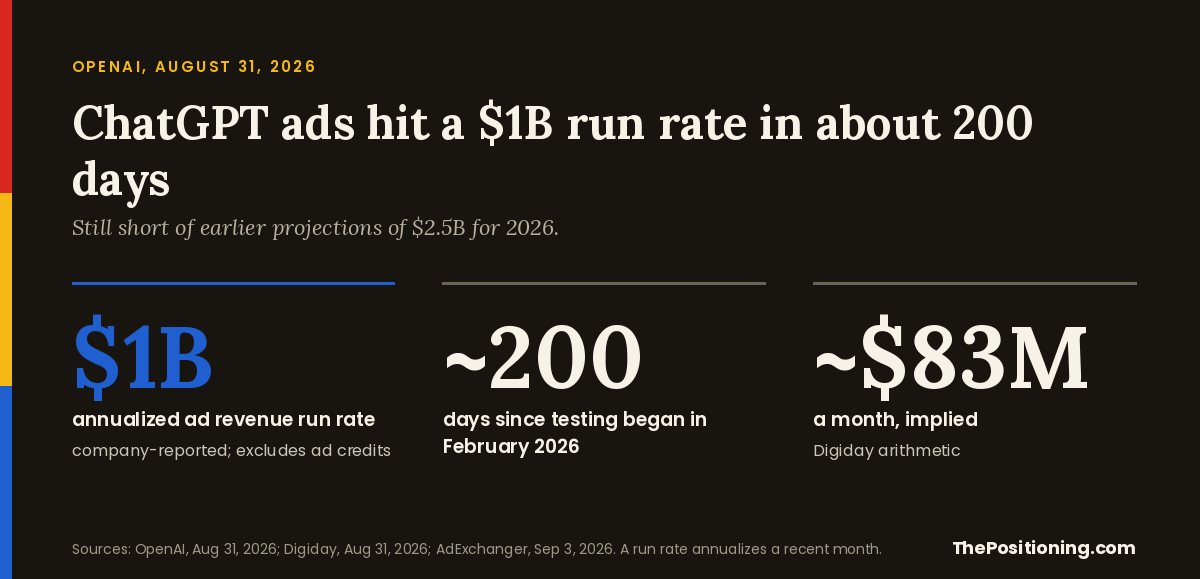
Two things about that figure. It’s OpenAI’s number, not audited revenue, and a run rate annualizes a recent month. I wrote a whole piece on how to read a benchmark and the same discipline applies here. Digiday did the arithmetic: $1 billion annualized is about $83 million a month. AdExchanger noted that earlier projections had put 2026 ad revenue at $2.5 billion, and that the current pace is short of that.
Second, $83 million a month across every advertiser in the US and, since August, 31 European markets is a test budget in aggregate, big enough to be of interest but so small that almost none of it has as yet survived the planning cycle.
This is why the question of partners is crucial now. Whether ChatGPT ads move from test to plan gets decided in the 2027 plans being written this quarter, and that comes down to measurement.
Purchase data is growing several times faster than the open web
While ChatGPT alone would make for a rather thin argument, the Q2 results of the three companies at the center of this story also point in the same direction.
Amazon’s Q2 2026 results, released July 30, put advertising services revenue at $19.8 billion, up 26% from $15.7 billion a year earlier. That’s a business the size of a large-cap company growing faster than most startups.
Walmart’s Q2 FY27 release on August 20 reported Walmart Connect in the US up 43% excluding VIZIO, and the global advertising business up 38%. On the call, CFO John David Rainey said “almost half of the growth” in profit “came from areas like membership, advertising, marketplace.” A grocery retailer is telling investors that ads are a profit engine. That sentence would have been absurd in 2019.
The Trade Desk’s Q2 2026 results, released August 6: revenue of $715 million, up 3%.
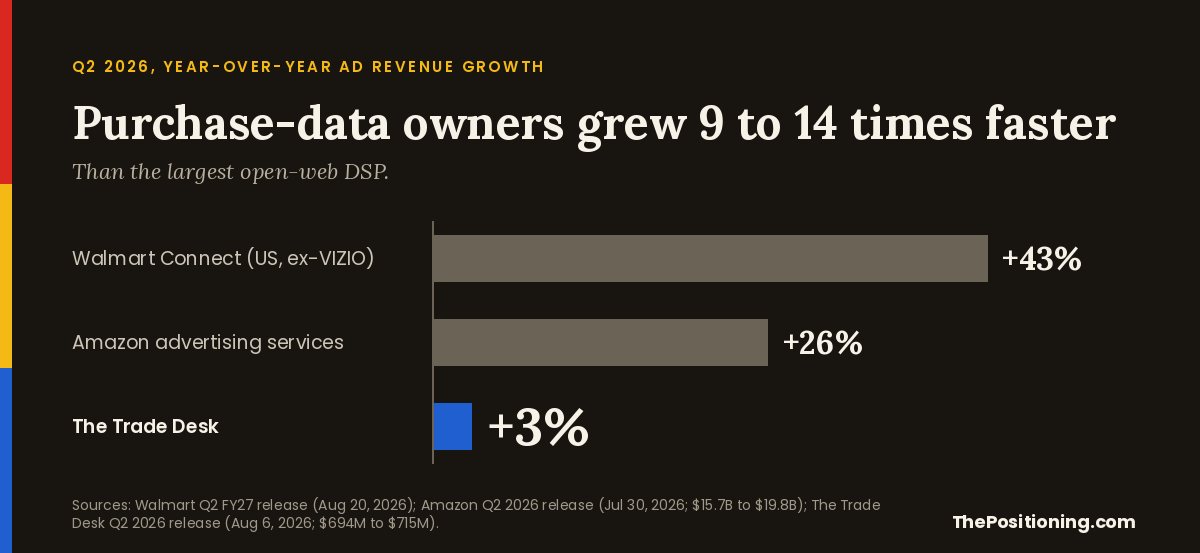
The lazy version of this argument says Amazon ate The Trade Desk. TTD’s management says otherwise, and I’ll come back to that. My argument is far more narrow. Advertisers are paying for media with a receipt attached. Companies that can attach a receipt to their media are growing several times faster than ones that have to borrow the receipts from somebody else.
I also made the point in why brands are becoming media companies: whoever owns the customer relationship owns the media around it. So, for example, retailers own the shelf, the checkout and the record of what people bought after seeing which ads.
The proof stack: what a new ad surface needs to earn budget
I’ll use the following model to think about any new ad surface, including ChatGPT: the proof stack. For a surface to be considered for planned budget (as opposed to test budget), there are three layers of proof that must exist. These proof layers can be held by different companies.
Inventory. A place to put the ad, of sufficient scale and attention to be of value. OpenAI has such a place, as do all retailers with an app.
Purchase signal. This is information about people in market and what they have bought. It enables the ad to reach the right people. Conversation context is a strong signal of interest but a weak signal of purchase history.
Closed-loop proof. This is the proof that ads lead to sales. Ideally it can be done in a ‘clean room’ that advertisers can query, ideally with a holdout group to show the sales would not have happened anyway. This is the layer that enables tests to be turned into line items.
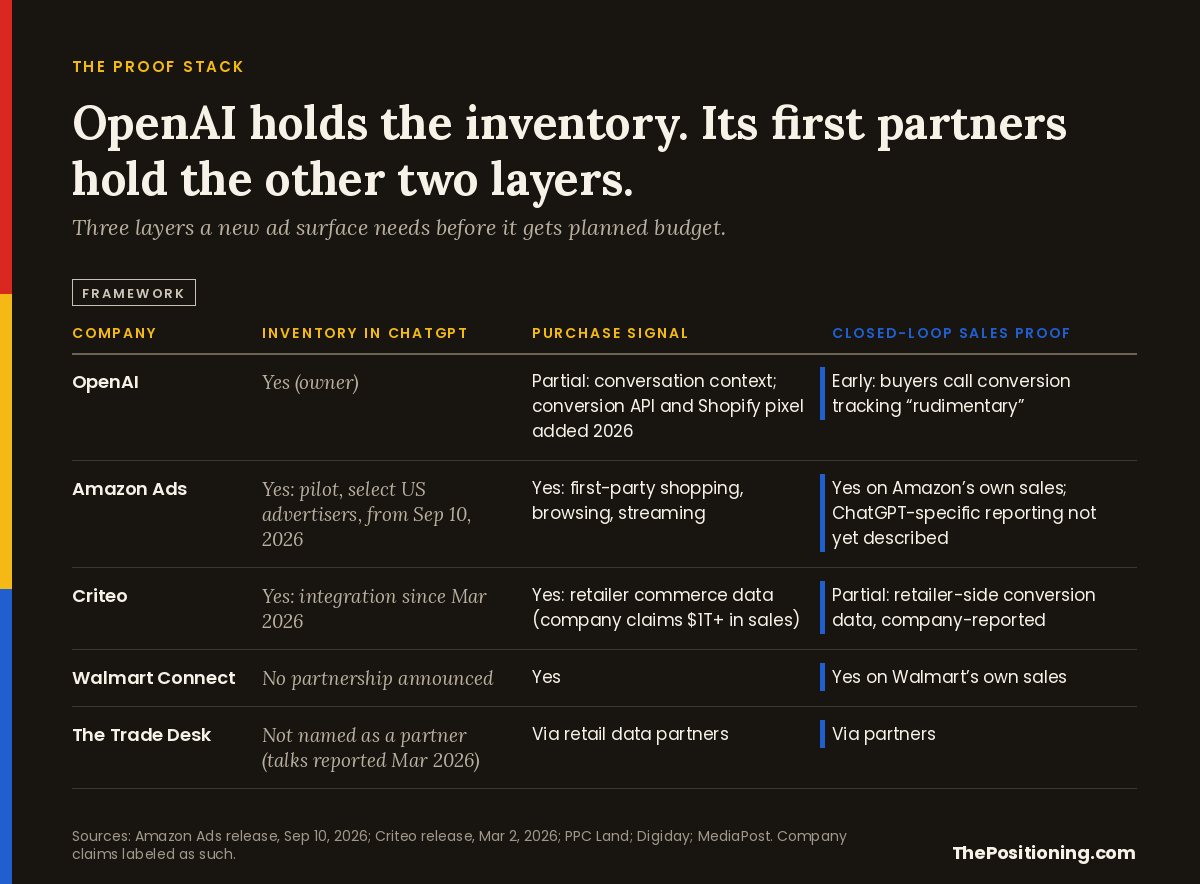
Lay it out like that and the partner list stops looking random. OpenAI owns the first layer outright. It’s building toward the second and third itself: in September it launched integrations with HubSpot and Shopify, and the Shopify app installs a server-side pixel and reports conversions and cost per acquisition inside Shopify. That’s OpenAI collecting its own receipts from merchants, one storefront at a time.
The fastest way to fill out layers two and three of the proof stack for big advertisers today is to plug into someone who already has them at scale. Criteo has conversion data from retailers, Amazon has first-party shopping data on its customers plus a measurement stack lots of advertisers already use. Each of them shows up with all three layers once you add OpenAI’s inventory.
An open-web DSP brings a fourth thing, reach across everything else. This is very valuable but not the layer that ChatGPT is missing.
Steelmanning the convergence story
The best case against my argument is The Trade Desk’s own. In the Q2 call with Jeff Green, CEO of The Trade Desk, he said “Participating retailers on our platform now represent more than 80% of U.S. retail sales.” If that’s right, TTD can bring purchase signal to ChatGPT inventory as well as anyone, just assembled from many retailers instead of one. That’s the convergence story in a sentence. It’s not silly.
But there’s another strong counter. OpenAI enabled self-serve purchasing in May and Shopify and HubSpot integrations in September. A brand doesn’t even have to use Amazon to buy ads with ChatGPT. If OpenAI builds conversion measurement that is any good, the retail-media door becomes optional and the whole partner sequence is but a temporary scaffolding.
And a third counter, as Digiday reported: Amazon’s fees for programmatic guaranteed often approach zero, while TTD has historically been associated with 15%-20%. Perhaps Amazon DSP was chosen because it was cheap, not because of its data.
I take all three of these things seriously. My view is that borrowed retail data is of less value in a negotiation than owned retail data because the retailer can sell it directly (and Amazon and Walmart increasingly do). Self-serve is great for small advertisers but doesn’t solve the large advertiser’s problem of proving incrementality to the CFO. Low fees explain why a buyer picks one DSP over another, but they don’t explain as much about why OpenAI would choose to partner with Amazon and Criteo. OpenAI’s scarce resource is credible proof, and that’s what Amazon and Criteo sell.
Your retail media contract is now your AI ads contract
For brands selling on Amazon or Walmart, their Retail Media Agreement (RMA) is no longer simply a “shelf ad” deal. It will be the most viable avenue for your company to buy measured Artificial Intelligence (AI) answer inventory in 2027. Negotiate as such.
Three asks, in this order.
Test access to conversational inventory in the Amazon pilot for select US advertisers. Ask your Amazon Ads team in writing what the criteria are for getting in, what the minimum commitment is and whether any ChatGPT inventory will be included in any upfront 2027 or annual commitment you are looking to commit to. If you are spending a lot on Amazon retail media then ask why you are not in the pilot.
Clean-room rights to ChatGPT exposure. Amazon’s announcement doesn’t describe ChatGPT-specific measurement. That is the gap your contract language needs to close. You want to be able to measure ChatGPT ad exposure in the clean room of choice for Amazon today and tie it to sales, with the ability to run a holdout as well. If the exposure can’t be tied to sales, then you are buying the same unproven intent you could buy directly from OpenAI, at a markup. This is the same discipline that I previously argued for in the full-funnel attribution: measure the channel against revenue or do not scale up the channel.
Fee transparency and a cap. Whatever Amazon’s DSP fee is on your other deals, get the ChatGPT line itemized and capped. A new surface with scarce access is exactly where intermediary fees creep. Note that the FTC and 22 states sued Amazon on August 31, alleging its ad auctions charged advertisers more than they were told. That’s an allegation, not a finding. What it means for your bids is covered in Google, Microsoft and Amazon Now Set Your Ad Prices. It’s also a reason to want the number in writing.
If you don’t sell through a major retailer, your situation is different, and harder. You can run ads on ChatGPT through OpenAI’s Ads Manager, through Criteo or StackAdapt, or through an agency holding company. However, what you can’t easily get is the same level of sales proof as a retailer. Therefore, you should design your test to generate the proof you need. This could be a geo or audience holdout, a dedicated landing path for the test, etc. All of these would need to have the conversion API wired in on day one. Treat this as a test that you intend to graduate and state up front what the bar for graduation will be. Otherwise, it will sit in the experimental line of your organization, where, according to the AdExchanger buyers, most of this stuff sits today.
What this does not mean
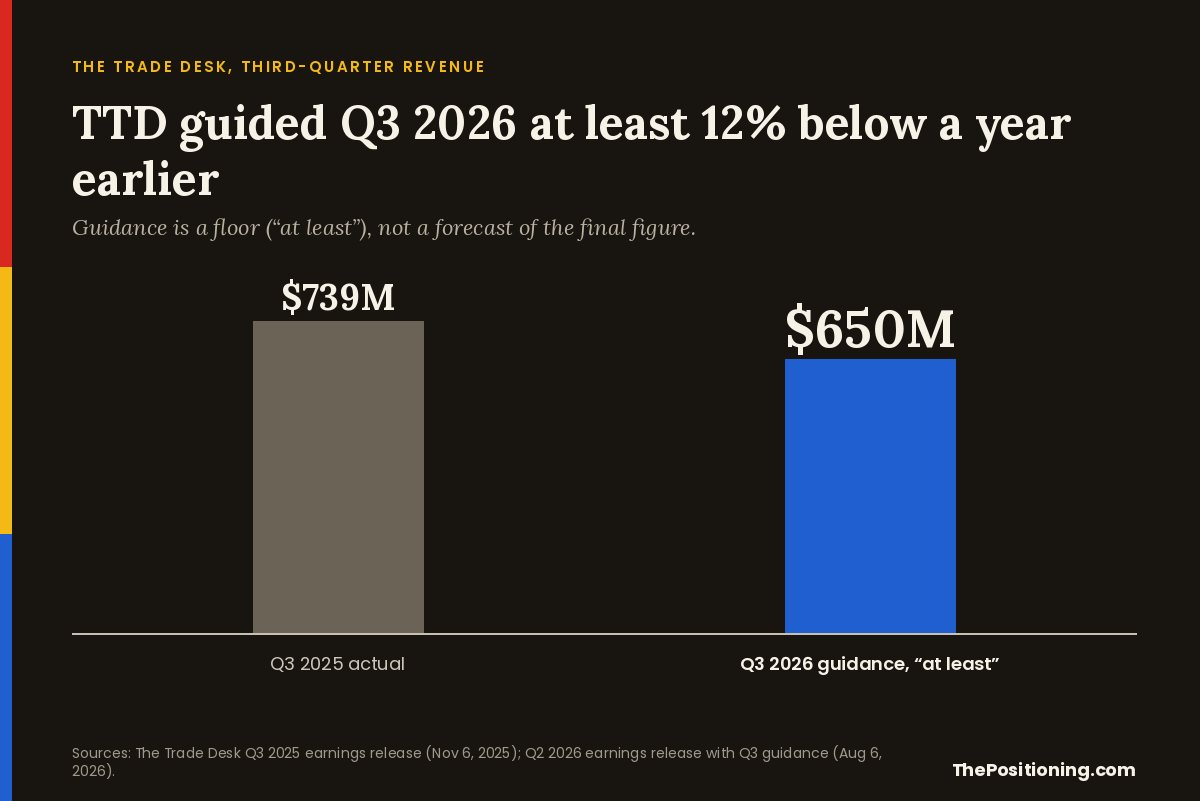
It doesn’t mean Amazon caused The Trade Desk’s slowdown. TTD guided Q3 revenue to at least $650 million against $739 million a year earlier, and in early September disclosed in an 8-K a workforce cut of about 15%, more than 500 people per StreamTV Insider, with $39 million to $51 million in restructuring charges. But management’s explanation on the Q2 call was macro and execution. Green said “autos and CPG have both been set back by tariffs and oil prices,” and that “we didn’t execute as well as we could have.” He didn’t name Amazon or ChatGPT as causes. I think the structural shift is real, but nobody can untangle it from a tariff-hit CPG category in one quarter, and I won’t pretend to.
This is not necessarily a large pilot. It is limited to select US advertisers and there is only one named brand. Terms, targeting and measurement are not published.
It doesn’t mean $1 billion is booked revenue. It’s OpenAI’s own run-rate figure, from OpenAI’s own blog.
And the door isn’t closed. Other major DSPs, TTD included, may well get ChatGPT ads within a year. OpenAI has every incentive to have as many buyers for its product as possible, and nothing in the public record says Amazon has exclusive rights.
The order in which new services are opened to buyers tells us what they lack. ChatGPT first tried to find receipts. In advertising, whoever holds the receipt sets the price.
Sources: Amazon Ads, “Amazon Ads and ChatGPT advertising integration,” 10 September 2026 (pilot for select US advertisers; Delta Vacations among first brands; quotes from Chris Conetta, Amazon DSP, and Katrin Koenig, Delta Vacations). Digiday, Seb Joseph, “Amazon Ads brings advertisers to ChatGPT, extending its supply-chasing streak,” 10 September 2026 (Amazon DSP fees often near zero on programmatic guaranteed vs TTD’s historical 15–20%; Criteo and StackAdapt already integrated). OpenAI, “A milestone in expanding access to AI,” 31 August 2026 ($1B annualized run rate, about 200 days). Digiday, Seb Joseph and Krystal Scanlon, 31 August 2026 (Dave Dugan quote; ~$83M a month; 31 European markets; self-serve in Europe). SiliconANGLE, Mike Wheatley, 31 August 2026 (February testing start). AdExchanger, Joanna Gerber, 3 September 2026 (advertiser measurement needs; run rate excludes ad credits; earlier $2.5B 2026 projections; conversion API). Criteo press releases, 2 March 2026 (first ad-tech partner; $1T+ commerce sales claim) and 5 May 2026 (1,000+ brands). PPC Land, 11 May 2026 (StackAdapt joins; self-serve Ads Manager opens to US businesses 5 May) and 16 September 2026 (HubSpot and Shopify integrations; Sponsored Agents test). MediaPost, 5 March 2026 (TTD reported talks with OpenAI; shares up about 21% to $30.32). Amazon Q2 2026 earnings release, 30 July 2026 (advertising services $19,809M vs $15,694M, +26%). Walmart Q2 FY27 earnings release, 20 August 2026 (Walmart Connect US +43% ex-VIZIO; global advertising +38%) and earnings call (John David Rainey quote). The Trade Desk Q2 2026 earnings release, 6 August 2026 (revenue $715M, +3% from $694M; Q3 guidance at least $650M) and earnings call, 6 August 2026 (Jeff Green quotes); Q3 2025 earnings release, 6 November 2025 (revenue $739.4M); Form 8-K filed 4 September 2026 (~15% workforce reduction; $39M–$51M charges). StreamTV Insider, 9 September 2026 (more than 500 employees). FTC press release, “FTC, States Sue Amazon Over Secret Ad Surcharge Scheme,” 31 August 2026 (allegation).
AI was used in research and formatting.

Written by
Ryan Frazier
He’s spent 18 years building and leading marketing teams, from Series A startups to multi-billion-dollar public companies — four of them scaled past the $50M, $100M and $250M ARR marks, and all four through to acquisition. He writes The Positioning, on why winning has less to do with being right than with being well-positioned at the convergence of time, place, and resource.
More about Ryan →