The PMM Career Ladder Assumes a Team You Probably Don’t Have

Most descriptions of a product marketing career ladder look something like this: Associate PMM, PMM, Senior PMM, Principal PMM, Head of Product Marketing, VP Product Marketing. That picture is accurate for a company with a product marketing department, but most product marketers do not work at one.
This year’s Product Marketing Alliance survey of product marketers found that 29% of respondents are the only product marketer at their company, and another 48.9% are on teams of two to five product marketers. That’s nearly 78% of the profession working on teams too small to have more than a couple of levels. On a team of one, the level above you is another job at another company.
That changes what progression means, and it is the PMM version of a problem that we looked at across marketing in The Career Ladder Is Still on the Org Chart. The Climb Isn’t. Without rungs to climb, a product marketer advances by taking on scope or by moving to another company or function. Each of these options has its own evidence and its own potential pitfalls.
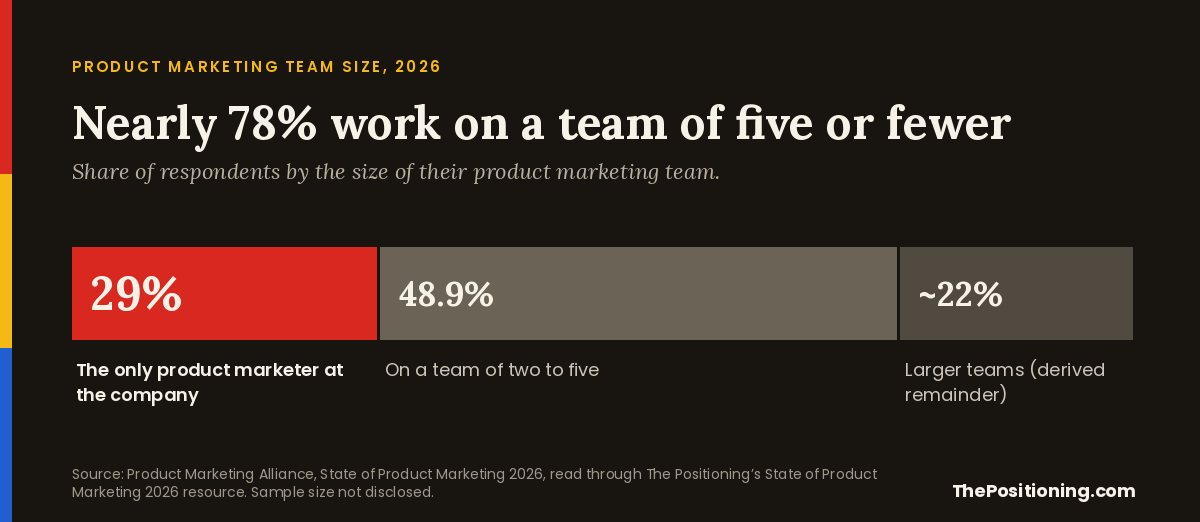
Most product marketers work on a team too small for a ladder
The PMA survey did not disclose the sample size, but the respondents were mostly practitioners with 61% of them being PMMs or Senior PMMs, 3.7% of them being VPs and 48% of them having five years or less experience in the field. The numbers reflect the shape of the working profession, not a census. The shape is that of a function with a wide base and almost no top, which is what you would expect when most companies hire product marketers one at a time.
This matches what the hiring side is saying. In the 2026 hiring research from Fluvio (a product marketing recruiting and consulting firm), about 40% of experienced candidates’ job searches were for companies that either had no product marketing function or had only one PMM. Many of the experienced candidates were looking to be the entire department for a company.
There is some positive movement around reporting lines as PMA found that 20.2% of product marketers now report into the CMO (up from 16.4% a year earlier). That buys visibility, but not a Senior PMM title to be promoted into as the person above you is a CMO and the person to your left is a product manager.
Without rungs, scope is the promotion, and scope is inflating
When a ladder is absent, scope is the substitute. 35.1% of PMA respondents support 6+ products (up from 29.3% in 2025). 41% of Fluvio’s newly hired PMMs said their scope was unrealistic for one person, and 72% said that AI has set higher expectations for their output.
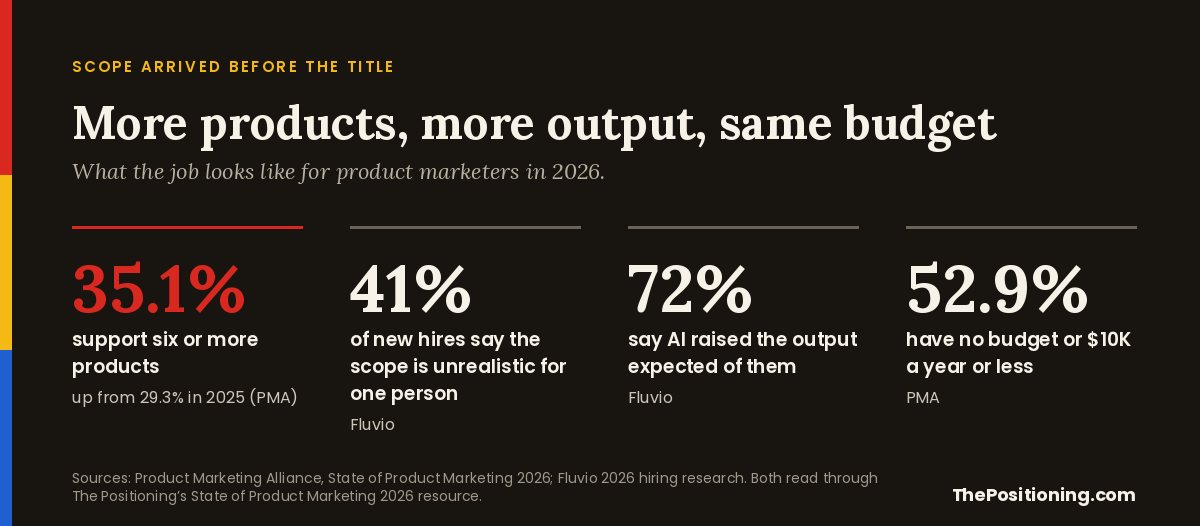
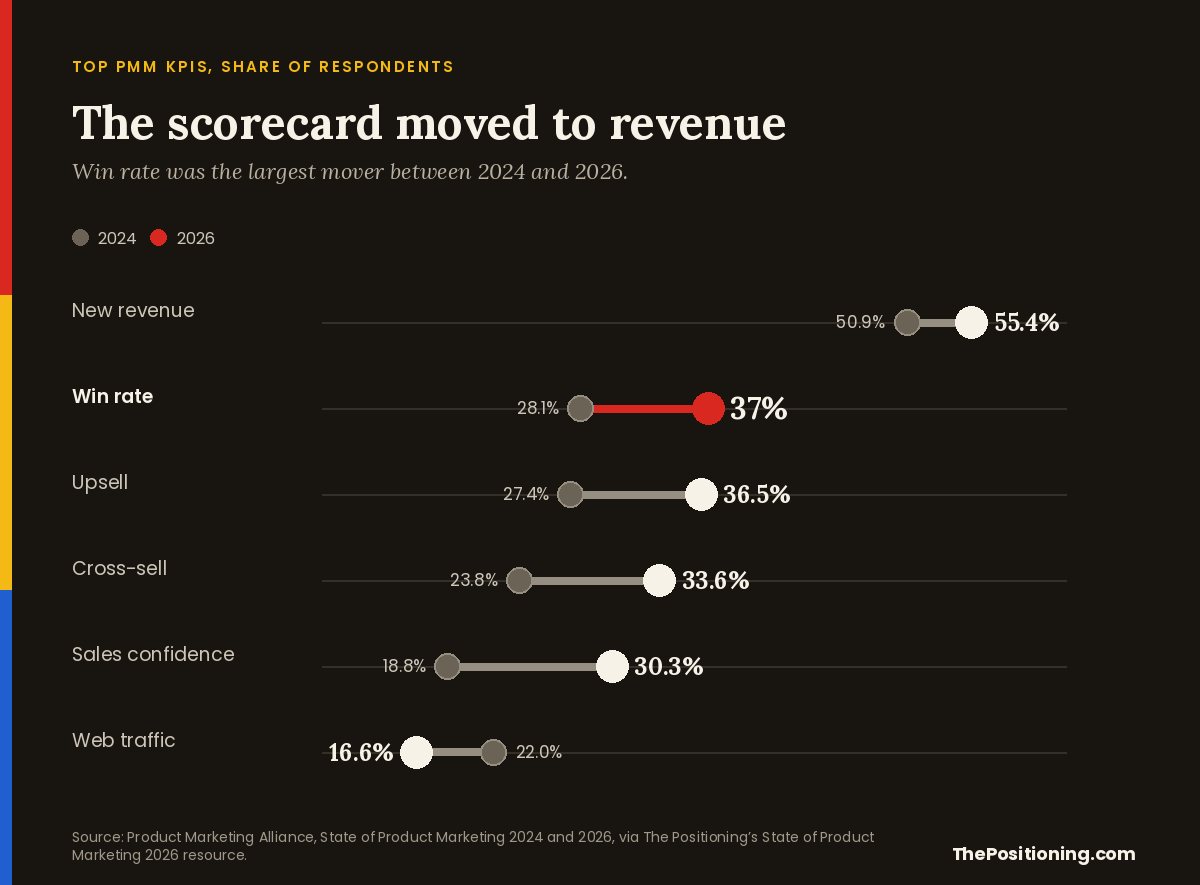
Budget did not travel with the scope. In our own State of Product Marketing 2026 analysis of PMA and 15 other public sources, 52.9% of PMA respondents have no budget or $10,000 or less per year. And the scorecard changed under them: generating new revenue is the top KPI at 55.4%, while win-rate targets increased from 28.1% in 2024 to 37% in 2026.
Put those together and taking on stretch projects stops being career advice; it is the job description. The relevant question to ask is whether more scope also brings more decision rights. Who approves the messaging? Who owns the number? Who is in the room when pricing changes are made? Scope with authority is a promotion that has not yet been paperwork. Scope without authority is simply more work with the same title.
The function also still has to explain itself. 36.9% of PMA respondents rate internal understanding of product marketing at 1 or 2 out of 5, and only 23.1% rate it 4 or 5. A promotion needs a sponsor who can describe your work to the person who approves headcount. When the people above you would score the function a 2, that sentence is hard to say.
The top of the market is healthy, which makes the squeeze hard to see
Product marketing had a very good year in terms of demand for the role. Taligence’s Q1 2026 report for product marketing listings found that there was a 12.2% year-over-year increase in listings for product marketing roles and that product marketing had the highest median advertised pay of any marketing function at $156,000. Director-level and above roles comprised approximately 13% of all listings for in-house US marketing roles. PMA’s December 2025 research found that median base salary for product marketing roles worldwide was $119,000 and in North America was $147,000. Robert Half’s 2026 midpoint for US PMMs is $113,000. Pay data varies by who is counted, and the gap likely reflects who each one samples.
Getting in at the senior end is harder. Fluvio found that almost half of Director and VP candidates were looking for 6 months or more, up from about 35% the year before, and 35% of them received no offers at all. The top rungs are there, the money is there, but the line to get there is long. This is the “crowded top” problem from our broader career-ladder data, applied to one function.
Leaders want out, and the sources disagree about how badly
PMA’s May 2026 article on where product marketing leaders go next, which its listing labels as sponsored content and which draws on a gated eBook, reports that about three-quarters of PMM leaders feel strong support from company leadership. Its own framing is that recognition and progression are not the same thing: 40% of leaders want to move up at their current company within the next 12 months, over a third are actively looking to move to another company and only one in five intend to stay put.
The wider PMA survey of the State of Product Marketing tells a calmer story. Here 38.5% of respondents would like to move up in their current company and only 9.4% plan to change both employer and role. The two sets of research cover different populations: PMA describes the leader research only as hundreds of leaders, while the State of Product Marketing sample is mostly practitioners with 5 years or less experience and its size is not disclosed. If you are a senior PMM, the leader data describes your peers; if you are earlier in your career, the calmer number may be closer to your reality. Either way, the people at the top of this function are more restless than the people below them.
The next step is usually sideways

PMA names four career paths for senior PMMs: chief of staff and other strategic roles, the CMO path, product leadership, and fractional or advisory roles. One contributor frames the common thread as a hub-and-spoke structure. Product Marketing touches product, sales, customer success and the rest of marketing. Thus a leader of Product Marketing can pivot to any of these spokes.
This is also consistent with other data. The Burning Glass Institute’s study of 1.3 million individual career histories showed that mid-career individuals who switch to adjacent positions with steeper trajectories substantially reduce the risk of a stall in their career, and that marketing specialists experience a lower rate of stalls than most professionals (12.2% vs. 24.2%). The adjacent move is effective because there are many overlapping skill sets. For example, product marketing has more overlaps with other functions than most other roles.
Caution should be exercised with the CMO path. The average S&P 500 CMO serves for 4.1 years according to Spencer Stuart research. Of the 218 CMOs that departed in the past five years, 9% went on to become CEOs, 13% became divisional CEO, President or COO. A CMO role is a high profile position and can be a short lease on a job. It is as important to monitor the exits as it is the entrance.
Revisiting the fractional path in light of the data for team size is also worthwhile. If about 40% of experienced candidates’ searches land at companies with no PMM function or one PMM, then a lot of companies are searching for product marketing and can’t staff up to a department of full-time PMMs. Fractional and advisory work is how a senior PMM sells into that gap without becoming the only PMM at a company that does not yet know what the role is for. This is an inference from two separate data points, not something the two reports measured.
There are fewer places to be the first PMM
One reason so many PMMs work alone is that companies bring them on as the first person to build out product marketing as a function. However, the path to building out product marketing as a function is narrowing. PMA’s data on the distribution of PMMs at different stages of PMF shows that the share of PMMs at pre-product-market-fit companies has fallen to 5%, while the share of PMMs at early post-PMF companies has fallen to 14.2% from 18.3% in 2024.
Hiring at VC-backed startups is also down. Carta data for January 2026 shows VC-backed companies made 26,030 new hires, the slowest January since 2018. New hires exceeded departures by 1.3 to 1 in January 2026, compared to 3.8 to 1 in January 2022. Average Series B headcount is down to 45 people from a peak of 53 in 2023. The median seed-stage team is four people. Carta’s head of insights says it would be inaccurate to attribute the decline in startup hiring entirely to AI, since funding discipline explains much of it, though many founders report delaying hiring because AI tools can be used by small teams to make up for lack of personnel.
If “first PMM at a startup” was one of the ways for a product marketer to gain broad scope fast, there are fewer of those seats now. Note that this is an inference from two datasets, and not a finding from either of them. Please test this hypothesis against your own network.
The associate rung is the part AI does best
This low end of the ladder is where things get ugly. The job of the Associate or Junior PMM consists of lots of production work: creating and maintaining the content of many decks, one-pagers, web copy, battlecards, launch plans etc. PMA’s respondents use AI for messaging and positioning development (83.4%), for market or competitive research (78.5%) and for content creation (74%). 80.1% of respondents use AI regularly. This is the work that a Junior used to do to learn on the job.
Governance has not caught up. Of the PMA respondents only 6.9% said they had a formal AI process. According to Klue’s 2026 research of competitive intelligence and PMM professionals, 76% had an output of AI that they could not stand behind. According to Crayon research 80% of teams use AI to create sales-facing competitive content, up from 25% in 2024. These are vendor studies, but the point stands: the first draft got cheap, but the judgment as to whether it is correct or not did not.
This is the same pressure as reported by Gartner’s September 2026 survey of marketing leaders where 18% of the respondents had already eliminated jobs due to automation; Gartner advised redesigning entry-level work instead of eliminating it. For product marketing the question of redesigning the associate role is very concrete. If the associate no longer writes the first draft of the battlecard, then what does the associate do in year one? The answer to build future Senior PMMs is judgment work. This would include checking the output of the AI against customer conversations, sitting in on lost-deal reviews and then owning the win/loss readout for the team. Companies that hand juniors that work, giving up some efficiency in order to build a function with a bench will be much better off in five years than those who don’t and find themselves with no Directors.
Run the Climb Check on a function that has no ladder
The Climb Check from the wider career-ladder analysis can be translated to product marketing with three questions to answer for the PMM version of the problem.
The rung question: is there a level above you at your company, and is someone in it? If you are the only PMM at your company, then the honest answer is no, and the next rung up would be at another company, or in another function. This is useful information to have in year 2, not year 6.
The route question: who was promoted into Senior or Principal PMM in the last two years, and from where? If the answer to this question is ‘Nobody’ or ‘Someone from outside’, then internal promotion is clearly not the route, even if it is stated in the career framework.
The proof question: which revenue number can you point to? 55.4% of PMMs report New Revenue as their top KPI, with Win Rate at 37% and Upsell at 36.5%. For proof, you need to provide evidence of either the win rate for the segment you repositioned, the pipeline for the launch you ran, or the expansion revenue for the messaging you changed. A launch calendar is activity. A number is proof.
What to do Monday morning, as a PMM or as the leader above one
If you are a product marketer, pick one revenue-linked KPI and get it in writing as yours: how it is measured, who agrees on it and what you can influence. Write down the decisions that are within your scope. In the next review you’ll be negotiating with evidence about authority, not asking for a title. Build one deliberate relationship with a spoke (product management, sales operations or customer success, whichever you would move toward if the PMM path stalled), then pull the posting for the title one level above yours at three companies you would work for. If the responsibilities read like your current job plus ownership of a revenue number then you know exactly what the gap is.
If you lead PMMs, define levels even if the team is just 3 people. Then, specify what decision rights and revenue accountability a Senior PMM has. That way promotion doesn’t depend on a department you haven’t hired yet. And when you load a PMM with six products, say out loud what you are taking off their plate. Otherwise, you’ve simply promoted the workload of the person, not the person themselves.
What this does not prove
The PMA survey and Fluvio’s report both withhold their sample sizes, the leader piece is labeled as sponsored, ‘nearly 78%’ is our own sum of two PMA categories (29% plus 48.9%) rather than a figure PMA reports, the startup-onramp argument is an inference and, finally, none of these sources provide data on the actual promotion rate of product marketers – the best data on career progression that we found was the cross-function Burning Glass study. The picture is directional.
Taken together, the sources describe a ladder drawn for a department; a profession practiced mostly in a department of one; scope that increases faster than titles; and a market that rewards people who are able to attach themselves to a revenue number and keep their fingers in an adjacent pie. The ladder is real. It assumes a team you probably don’t have.
Sources: Product Marketing Alliance, State of Product Marketing 2026 (sample not disclosed); Fluvio, 2026 Product Marketing Hiring Trends Report (sample not disclosed); Taligence, U.S. Marketing Jobs Report Q1 2026; PMA, “Where do product marketing leaders go next?” (May 12, 2026; labeled sponsored); PMA, global product marketing salary research (Dec. 2025); Robert Half, 2026 salary data; Burning Glass Institute and NYU SPS, Sidetracked (2026); Spencer Stuart, CMO Tenure 2026 (Jan. 2026); Carta, State of Startup Compensation H2 2025; Carta’s Peter Walker on startup hiring and AI, via Angel Capital Association; Klue, AI in Competitive Intelligence Report 2026 (vendor research); Crayon, 2026 State of Competitive Intelligence (vendor research); Gartner press release (Sept. 29, 2026).
AI was used in research and formatting.

Written by
Ryan Frazier
He’s spent 18 years building and leading marketing teams, from Series A startups to multi-billion-dollar public companies — four of them scaled past the $50M, $100M and $250M ARR marks, and all four through to acquisition. He writes The Positioning, on why winning has less to do with being right than with being well-positioned at the convergence of time, place, and resource.
More about Ryan →